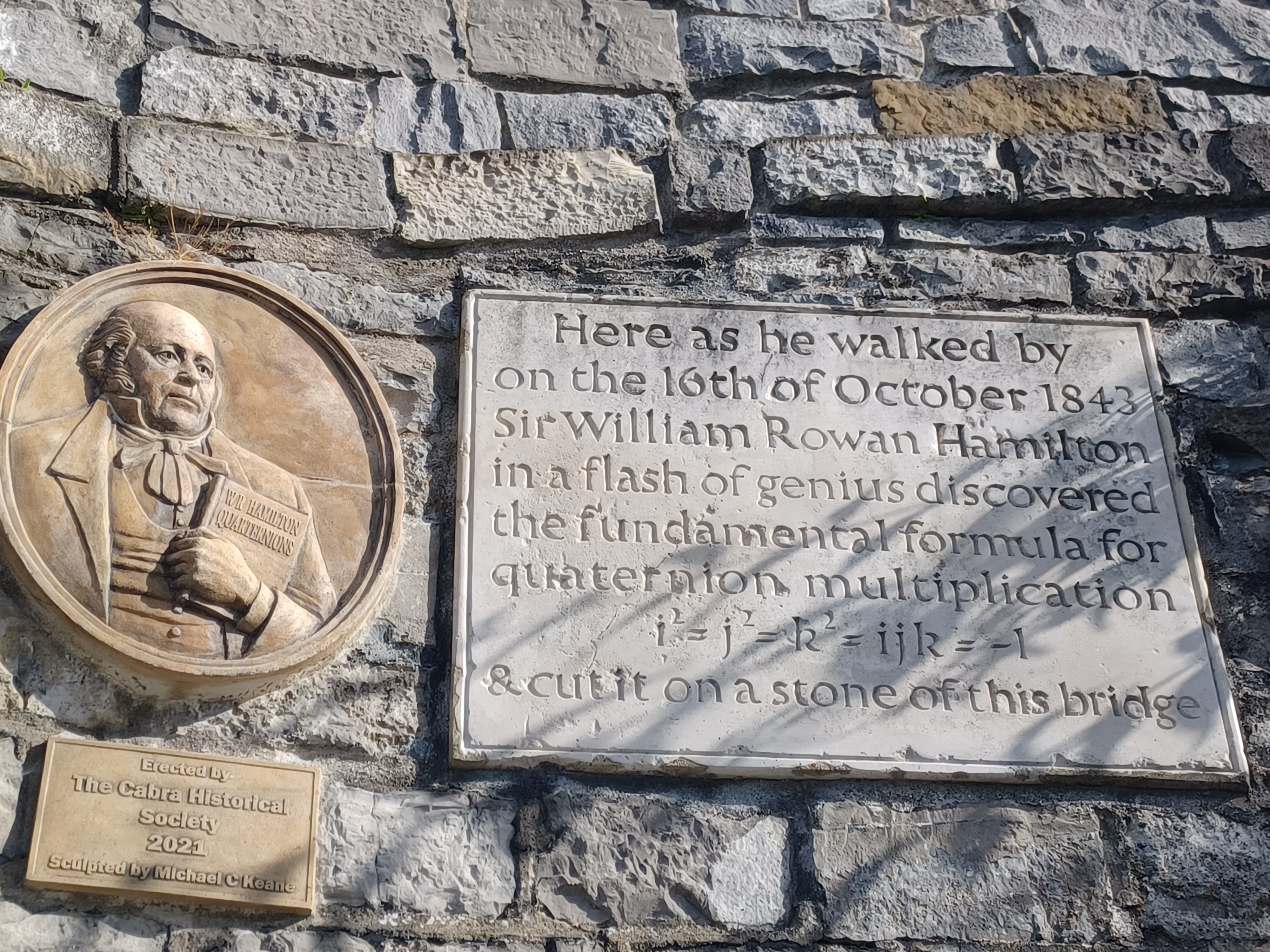
On the 16th October 1843, Sir William Rowan Hamilton was walking on the Royal Canal, with his wife, Helen Bayly, when, in a flash of genius, he discovered the fundamental formula for quaternion multiplication.
The formula was of course;
i2 = j2 = k2 = ijk = −1
In case he forgot it, he cut it into stone under the bridge, and later wrote to a friend,
“And here there dawned on me the notion that we must admit, in some sense, a fourth dimension of space for the purpose of calculating with triples … An electric circuit seemed to close, and a spark flashed forth”.
That’s when brains were brains.
When people would trip over formula while out walking along the canal and when people paid interest to the wanderings of the mind.
Hamilton had been living at Dunsink Observatory, with his four sisters, Grace, Eliza, Sara and Archianna, before he married Helen and was interested in algebra, classical mechanics and optics.
He also dabbled in poetry.
The Dunsink Observatory, built in 1785, sits on a hill between Finglas and Blanchardstown, and still houses wonderful books, photographs, paintings and astronomical instruments. There is a striking image of the earth, to scale, desperately close to the sun, which is spewing out gas. The earth, of course, looks insignificantly tiny, next to the ferocious sun that could accidentally dribble, and immolate us all instantly.
Dunsink time was different to Greenwich and Galway for most of the 1800s, only synching up at 3.00am on 01 October 1916, both during and outside of daylight-saving time. But that’s just legal time. According to the stars and the sun and the moon, Dunsink is, and will always be, twenty-five minutes and twenty-one seconds behind Greenwich mean time.
The main telescope is kept in a dome in the garden at Dunsink, and people still come to see it. It’s where they gaze at the stars and observe the moon, where they learn about the movements of the night, and admire constellations.
Glorious stars at nighttime.
Quaternions are a language to describe three-dimensional experiences.
A dancer will move, a sculptor shapes, a poet will express themselves and all this happens in space and time, and a quaternion is a way of describing these things to non-sentient beings, such as computers.
It’s a way of writing it all down, explaining it all, and keeping accounts.
Our turning earth is so strangely vulnerable as it oscillates through space and time. Its elegance and mysterious scariness changes as it drifts.
Further down the canal, in October 1843, the Hamiltons would have seen such beauties as grey herons and otters. Perhaps they waved at people on the canal boats or stopped to gossip to friends or neighbours. There would have been bees and honey, although it was too late for spotting dragon and damselflies.
They might have seen kingfishers; they might have smiled at the moon.
i2 = j2 = k2 = ijk = −1


Leave a comment