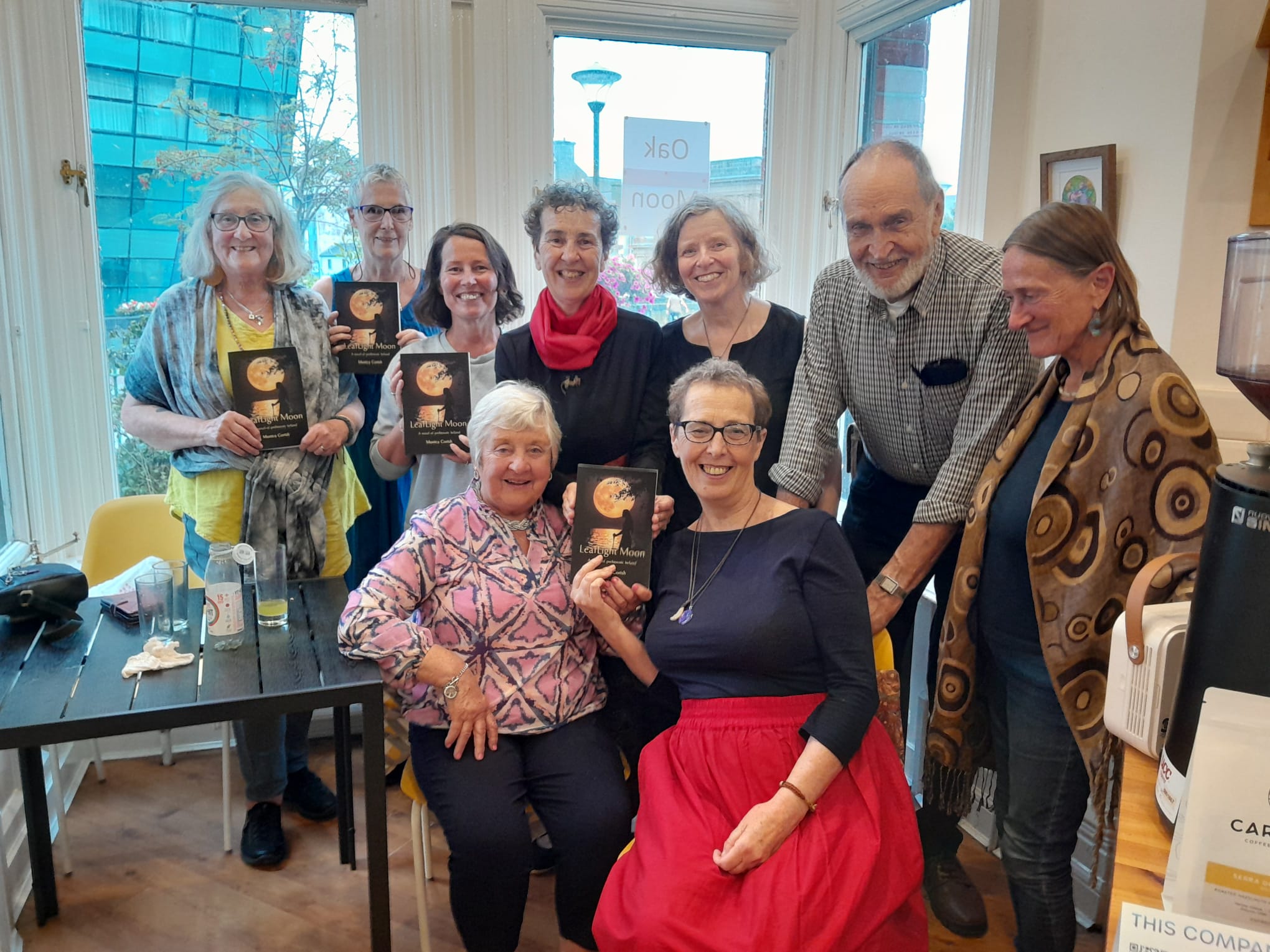
I first met Monica Corish in the old Irish Aid Centre at the top of O’Connell Street, Dublin, back in the summer of 2012. She was facilitating a creative writing workshop for returned volunteer development workers, and I loved the Amherst teaching method she used, and the lovely tone and style she applied to it. I left the workshop thinking, “that went very well”, and we started it then.
I attended many of her workshops after that. I went to more sessions at the Irish Aid Centre, then at the Comhlámh offices on Parliament Street and later again, online. I met her creative partner and partner in life, the writer, Tom Sigafoos and I enjoyed learning from her.
I always loved her poetry.
Her beautiful, “Slow Mysteries”, (2012, Doghouse), is a sublime collection of poems about Monica’s home, “and where are you from, and who are your people?” and Monica’s travels, both in and outside of Ireland.
In, “And yes, the waves were sparkling”, she takes us to Donegal Bay where the sea was “the happiest bluest turquoise/ I had ever seen” to Ntarama, Rwanda to witness “our own unbearable grief/ for the loss of unbearable joy”.
It’s testament to her skill as a writer, and creative coach that she can lead the reader safely through difficult terrain. And it’s those guide-like ways that have come into their own in her debut novel, “Leaflight Moon” (2025, Púca Books).
“Leaflight Moon” is a story of Sligo, Ireland in 4000 BC, when our ancient hunter gather-ancestors, met the first farmers, who cut down trees and kept their animals in cages. It’s an extraordinary tale and it’s a wonderful story.
At first, this period of time, might be disorientation for readers without knowledge of prehistoric landscape. But what Monica does, and where some of her magic lies, is she treats her characters from six thousand years ago, with the same respect and dignity as she might new friends from the coffee shop, from across the street. She assumes they have desires and fears, and she gives them voice, through her poetic prose.
Monica describes the landscape of the time beautifully.
“The waning-crescent Moon moved slowly through a cloudless sky. The sea was perfectly calm, the horizon straight as a reed. They paddled past mountains – WolfHowl – Eyrie – Blade – Boar – all leafing green and speckled white with sloe thorn”.
Monica’s characters, who change names as they grow and learn more about the land, and their place in it, are fully capable of making mistakes, doing terrible things and learning from their tragic errors. Monica takes the reader by the hand and whispers, “I know this is a bit unusual, but I am a storyteller and a poet, and you can trust me. If you stay with me, I’ll show you a story as ancient as the moon”.
Some of her characters have issues with the newcomers, and their modern ways of doing things. Some of her characters fall in love, and experience pain, grief, sorrow and loss.
One of the interesting aspects of the pages, is how characters can sound so reflectively modern, without us suspending our disbelief. The assumption that they couldn’t possibly be as thoughtful as we are now, is removed, as it is their relationship with the land, the seasons, the animals and of course the moon, which leaves us lacking.
Whoever, “us” is.
Change is inevitable in this book and the desire for our species to adapt is essential if they, and we, are to survive.
“Leaflight Moon” needs concentration, in a world where our concentration is sold to the highest bidder. The reader has to orientate themselves in an unfamiliar setting and Monica is there to help us. Characters change names just as we are getting to know them, and we need to adapt if we are to keep up. Why shouldn’t our ancient ancestors get the attention they deserve as we sit around our virtual fires and listen to the stories under night fall?
I was lucky enough to go to the Sligo launch of “Leaflight Moon” and was delighted to meet so many alumni from Kimmage Development Studies Centre, where so many volunteer development workers studied either before, during or after their overseas work. And of course, the Yeats Centre, where the book was launched, was full of Monica’s supporters, friends, family and other story tellers.
I was then later delighted to hear that “Leaflight Moon” won, the Carousel Aware Prize (CAP), award for fiction and the Golden CAP for best independently published books, at the award ceremony in Chapters Bookstore, on 10 October, 2025.
Monica is a poet, creative coach, teacher and friend and now she is a successful novelist. She has done so much, over the years, to support other writers through her writing circles, workshops and mentoring. Her warmth and wisdom deserve the success she is having with this book, and I hope she is enjoying every moment.
Much love Monica,
From Ruth, Dublin.
You can buy copies of Leaflight Moon in Chapters Bookstore, and Books Upstairs (Dublin).

 Shorter than me
Leave a comment