
Tag: short-story

  • An I for an eye

    An I for an eye

    It is said that it is harder for a rich, young man to enter the kingdom of heaven than it is for a camel to go through the eye of a needle.  Thankfully, I’m not rich, young or male, so this is one problem I don’t have to give my attention to.

    Nevertheless, back in chapel, in south Wales in the 1970s and 80s I learned about the parable of the rich, young man and I imagined the camel squeezing itself, headfirst, through the tiniest of needles, that my mother kept in a pin cushion, in her corner of the room.  There were treasures in that corner, alongside her glasses, left-handed scissors that no one was allowed to use, chocolates, cigarettes, and tin boxes that housed other surprises such as cut-out articles from the newspapers and postcards from France.  There were new envelopes in that corner, waiting to be used, but rarely a camel.

    In Mongolia, they play camel polo on the main square with the two humped Bactrian camels, but not during mating times when the males can be violent and bite and spit and sit on other male camels.  Those camels too, were unlikely to fit through the eye of a needle.

    No one ever asked the camel if it wanted to complete the ridiculous and absurd task? 

    No one ever told it, what it would win, if it completed the task?

    The camel might respond, “no thank you.  Honestly, I’m grand as I am”.  Or it might speak Mongolian or Welsh.  It’s hard to know, for sure, where the camel’s back story begins or ends, and in any case how it says it doesn’t want to do something, is less interesting than the sentiment, to begin with.

    Do camels like the autumn?

    They might enjoy a change in air temperature, and the fading light, or perhaps it might make them melancholy.  Perhaps they welcome the start of the darker nights, as it gives them a chance to catch up with correspondence.

    All silliness aside:  some teachers said that the “Eye of the Needle” was slang for a tiny gate in the wall of the city, where traders would enter and exit before going back to the desert.  The camel driver, now must try time and time again to manoeuvrer the hissing, spitting frustrated camel into a smaller space.

    Gone was the freedom of the sandy dunes and mirages. 

    Replaced instead with a settlement of noisy people, pushing and moving and trading and being annoying.  Of course, the camel preferred the outside space with the wide-open expanse of sky, sand and nothing to set the time by.  No shadow, shade, remorse or regret, no horizon, or river or mountain.

    Gentle camels of the steppe, let us be.

    Watching my mother knit, crochet and sew is a wonderful memory that I can re-watch any time.  She could talk, drink coffee, watch TV and even nod off for a nap while knitting baby clothes and blankets, jumpers and doll’s clothes.  There was a rhythm to her quiet hobby, and it was all for her.  Someone ended up with the finished product, and then she started a new one, all over again.  It wasn’t for content or the spotlight; it was simply a hobby that she had.

    Now we can’t sneeze without recording it and blasting it out to the stratosphere to wait for validation and admiration.  On occasion, someone doesn’t like our sneeze or thinks our sneeze is offensive, or out of lane.  Then we curl up like a hedgehog and wait for the threatening enemy to move away and find something else to worry about.

    Camels don’t know that hedgehogs exist, and hedgehogs can’t even dream of camels.

    It turns out that ancient Greek scholars dispel the idea that the “Eye of a Needle” was slang for a tiny gate, after all. And so, we return to the fact that it was a metaphor all along. 

    A part of the story, a device, or a tool.
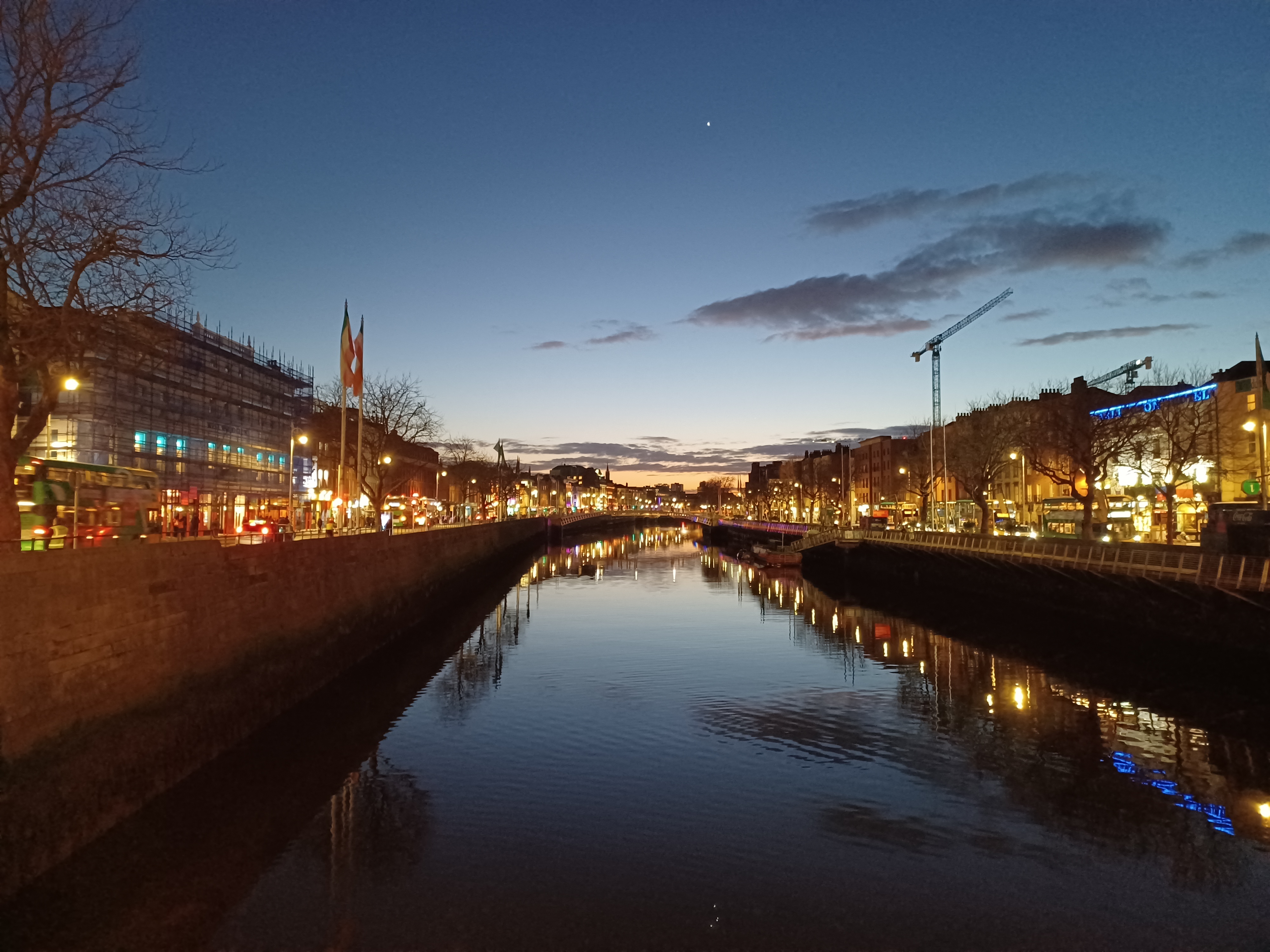
  • Made in Dublin

    I was the victim of crime.

    Or rather, I was nearly the victim of crime.

    Last week, as I was walking down O’Connell Street, a young man unzipped my rucksack and popped his hand into my bag to try and take my purse.  I didn’t notice his movements, which were as light as a ballet dancer’s.  I didn’t feel his breath on my neck, nor did I hear him.  I didn’t feel any difference in weight or speed as I walked at my normal pace, and he walked just behind me.

    What I did notice was that two other men, two plain clothes Guards, swooped in and stopped him, mid-crime.  One man took the would-be-thief, over to the Public Order Van, parked next to the Spire.  And the other plain clothes Guard walked me over to the wall of the GPO, to ask me some questions, and take my details.

    The man had to tell me a few times, that he was a plain clothes Guard, as I wasn’t sure what was happening.  He told me to check inside my bag, which I did, and I reassured him that everything was fine.  He wrote down my name, address and telephone number, and again, I told him that I felt OK. 

    Dublin has a poor reputation these days. 

    Everyone criticises it for being dangerous, unpleasant and harsh.  I’ve been like an eternal ex-girlfriend, singing its praises and defending it, despite the reality unfolding in front of me.  I see the correlation between political neglect, inequality, rising prices and a rise in crime.  But as it’s been my home for half my life, I still hate it when people are mean about it.

    That said, when I was nearly the victim of crime last week, I wondered if it was time for even me to finally say, “Dublin is shit”.

    The plain clothes Guard finished writing down my details.  Then he asked me where I was going for the evening and so I told him that I was on my way to my writing group.  I explained that it was more of an open-mic event, than a traditional writing session, and that it was filled with eclectic and inspiring writers.

    He nodded and said, “well good luck with that Ruth, and tell me are you more of a poet or a prose writer?”

    “Both!” I said enthusiastically.  “I’ve always written short stories and flash fiction or vignettes, if you will.  But recently I’ve started experimenting with poetry and I’ve had two poems published in a magazine called “Flare””.

    “That’s really wonderful”, the plain clothes Guard said to me encouragingly.  “Keep it up!”

    …and our thief, what about him?

    He needed to take something that didn’t belong to him. 

    There were at least 20 uniformed Guards on patrol that evening on O’Connell Street, and so his chances of getting caught were enormous.  Nevertheless, he thought it was worth the risk.  I don’t look like the sort of person who would have a lot of cash with me, or a fancy new phone, but he thought it would be worth his while to see what I was carrying.  Even if he had been successful, all he would have stolen from my bag was 20 euro, a Leap card, a 4-year-old phone, and a poem. 

    He risked it all for that.

    Later, after the writing session or open mic event, I walked back down Dame Street to take a bus home, and I saw plenty more Guards in groups, around the city, keeping its residents and visitors safe.  As a woman, walking to a bus stop alone in the dark, I was happy to see little groups of Guards.  But wouldn’t it be cheaper and better if we just made the city a little easier to live in, so that people don’t have to choose a life of crime?

    Couldn’t we just have a city where everyone had a home, no one needed to queue for food outside the GPO, and no one needed to try and steal from passers-by?  Where everyone had enough comfort and security to be able to call their lives, “real living”, and where we all looked after one another?

    Ireland is one of the richest countries in the world right now, with full employment and a big bank balance thanks to the Apple tax.  If we can’t accommodate everyone now, and give those who need a little extra help, a little extra help, then shame on us.

    The place I call home is magnificent. 

    But it could be so much better and brighter for all.