Tag: life

  • An I for an eye

    An I for an eye

    It is said that it is harder for a rich, young man to enter the kingdom of heaven than it is for a camel to go through the eye of a needle.  Thankfully, I’m not rich, young or male, so this is one problem I don’t have to give my attention to.

    Nevertheless, back in chapel, in south Wales in the 1970s and 80s I learned about the parable of the rich, young man and I imagined the camel squeezing itself, headfirst, through the tiniest of needles, that my mother kept in a pin cushion, in her corner of the room.  There were treasures in that corner, alongside her glasses, left-handed scissors that no one was allowed to use, chocolates, cigarettes, and tin boxes that housed other surprises such as cut-out articles from the newspapers and postcards from France.  There were new envelopes in that corner, waiting to be used, but rarely a camel.

    In Mongolia, they play camel polo on the main square with the two humped Bactrian camels, but not during mating times when the males can be violent and bite and spit and sit on other male camels.  Those camels too, were unlikely to fit through the eye of a needle.

    No one ever asked the camel if it wanted to complete the ridiculous and absurd task? 

    No one ever told it, what it would win, if it completed the task?

    The camel might respond, “no thank you.  Honestly, I’m grand as I am”.  Or it might speak Mongolian or Welsh.  It’s hard to know, for sure, where the camel’s back story begins or ends, and in any case how it says it doesn’t want to do something, is less interesting than the sentiment, to begin with.

    Do camels like the autumn?

    They might enjoy a change in air temperature, and the fading light, or perhaps it might make them melancholy.  Perhaps they welcome the start of the darker nights, as it gives them a chance to catch up with correspondence.

    All silliness aside:  some teachers said that the “Eye of the Needle” was slang for a tiny gate in the wall of the city, where traders would enter and exit before going back to the desert.  The camel driver, now must try time and time again to manoeuvrer the hissing, spitting frustrated camel into a smaller space.

    Gone was the freedom of the sandy dunes and mirages. 

    Replaced instead with a settlement of noisy people, pushing and moving and trading and being annoying.  Of course, the camel preferred the outside space with the wide-open expanse of sky, sand and nothing to set the time by.  No shadow, shade, remorse or regret, no horizon, or river or mountain.

    Gentle camels of the steppe, let us be.

    Watching my mother knit, crochet and sew is a wonderful memory that I can re-watch any time.  She could talk, drink coffee, watch TV and even nod off for a nap while knitting baby clothes and blankets, jumpers and doll’s clothes.  There was a rhythm to her quiet hobby, and it was all for her.  Someone ended up with the finished product, and then she started a new one, all over again.  It wasn’t for content or the spotlight; it was simply a hobby that she had.

    Now we can’t sneeze without recording it and blasting it out to the stratosphere to wait for validation and admiration.  On occasion, someone doesn’t like our sneeze or thinks our sneeze is offensive, or out of lane.  Then we curl up like a hedgehog and wait for the threatening enemy to move away and find something else to worry about.

    Camels don’t know that hedgehogs exist, and hedgehogs can’t even dream of camels.

    It turns out that ancient Greek scholars dispel the idea that the “Eye of a Needle” was slang for a tiny gate, after all. And so, we return to the fact that it was a metaphor all along. 

    A part of the story, a device, or a tool.
  • Too soon to tell

    Will the new year come with love and warmth and joy?  Will the bells sound of pleasure?  Will it bring with it, good cheer and peacefulness?  Maybe it’s too soon to tell.

    Better to try for attention and brighter mornings.  Tether the distraction to the wall.  Sing more, learn the jitterbug, walk slower through the day.  Purposely slow it down.

    Honestly, though, it’s just too soon to tell.

    The secret hush of the eve falls.  And like Janus, we see both years for the shortest of times.  While noting the past and the future we, ofcourse, miss right now.

    What did we learn?  What did we find out more about?  How were we kinder and more loving?  What did we give our attention to, and what filled us with excitement and delight? 

    Maybe just do more of that?

    When there’s a fork in the road, and we have to choose which path to take, how do we discern better?  Should we take the easy road, with the daisies and the smiling cow?  Or should we, instead, choose the harsher way, where the dragons spill out loss, sorrow and evil from their noses, and rancid pain from inside of their mouths?  There’s a better story in the poorer choice, and a stronger lesson to be learned.

    What to do if this year, is surprisingly sadder even than last year?  Yes, pain.  They said, “pain, my dear is a part of it” and it seems to be quite central.  I’m afraid.

    So it comes: another year of life.  Of this mystery and magic and gravity.  All that we are, were and will be, sits for a moment in quiet stillness.  Mistakes and sins, accolades and prideful times, sleep and starlight.

    Back straight, eyes forward.  Attention.  Love and kindness.

    Good luck everyone, good luck!

  • Everybody’s Having Fun

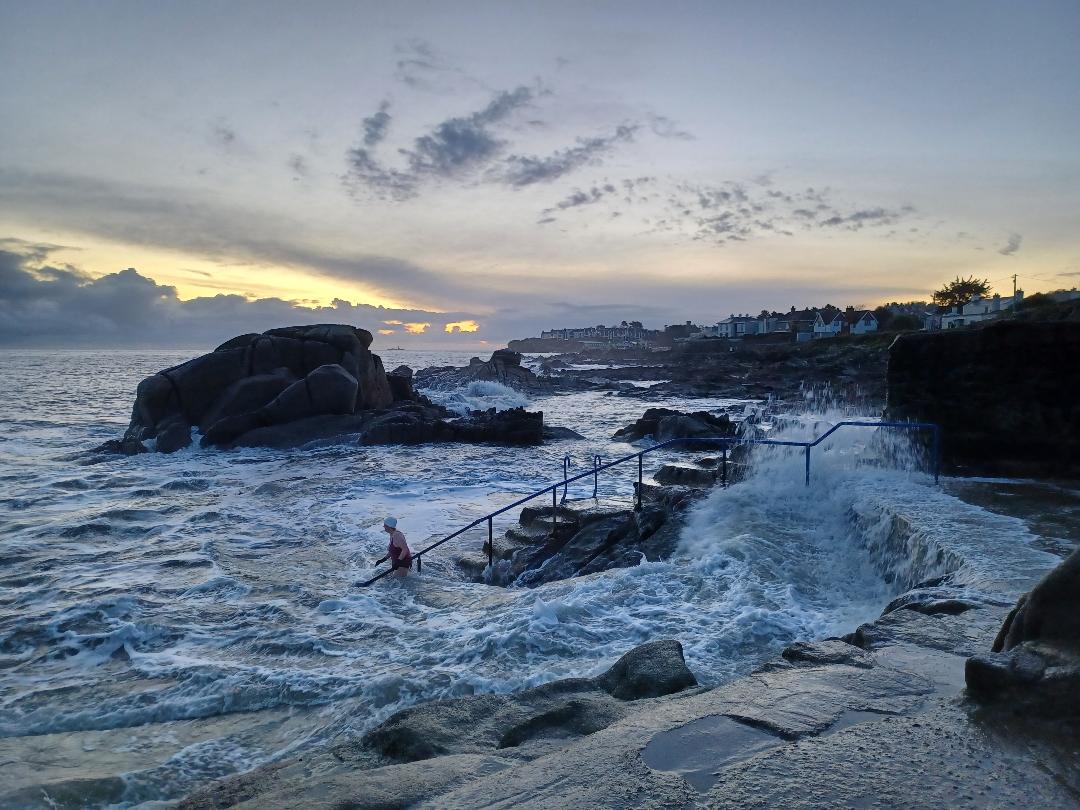
    Once a year, the Sun God demands a sacrifice, on the morning of the winter solstice, of three young maidens.  They are to wade into the cold water, and give of themselves freely, so that the rains can be secured for next spring.

    There were no fine, young maidens around yesterday morning, so Julia, Teresa and I threw ourselves into the Irish sea at 8.28am, in time for sunrise.  The Irish Sea quickly spat us back out again, as the sacrifice was unwanted.

    The three of us have been sea-swimming every weekend, from April until the shortest day, for five seasons and we have a very strong safety record.  Many a time we’ve abandoned a swim at the 40 Foot if it’s too wild, and we only ever swim at Vico on the calmest of days.  We only swim when there are others in the sea, and when our capabilities match the conditions.  We swim when it feels right.

    Yesterday, it didn’t feel right. 

    The wind and tide were low, but there was a very strong swell, which made it challenging to walk down the stone steps, into the sea.  More importantly, while there were lots of spectators, sitting on the rocks to enjoy the sunrise, there was only one other swimmer in the water.

    A random stranger took charge of us and began to give instructions.  We should go in via the side steps, we should time our entry and exit well, we should be careful and watch the high waves.  All of this was interesting and potentially helpful information, had we paid any head to him.

    Instead, what followed was a spectacular 90 seconds of seriously unhinged chaos.

    Julia was the first one to get battered into the railings, but undeterred she did a 360 turn around, caught her breath, and dived headfirst into the oncoming high waves.  Teresa followed steadily, with a magnificent belly flop into the cold water.  I didn’t even get off the steps before a wave took me under, and for a while I was neither on the steps, nor off the steps, but simply under the water circling around within the swirl.  Eventually, my hand found the railing, and I popped back up again, and waved at our Stranger-Instructor to tell him everything was OK.  Teresa and Julia stayed afloat for a minute, before climbing up the ladder, back to dry land.

    The sunrise spectators were watching, in horror from the rocks, as we dived, jumped and fell into the water.  They looked like a Greek chorus who could be singing, “why did you go into the water, on such a choppy day?  Why, why, why why?” 

    And why did we?

    I blame the Internet Machine.

    The Internet Machine has made babies of us all. 

    It makes me impatient, desperate for attention, unwise and envious.  There was a part of me yesterday, that wanted to go into the water for the photo I would be able to share on my social media.  My desire for the solstice swim, pictures and all, was stronger than the inner voice telling me to go around to Sandy Cove for a calmer swim.  No one would have minded if I hadn’t swum.  Yet, this is the life we live.

    We spend more time online than offline and even our offline lives are fodder for our content.  We over-share, post for likes, offer up our secrets and private moments in exchange for attention, and we make poor decisions.

    If I have one resolution this year, it is to leave my mobile phone at home more often.  I plan to treat it like a land-line, and leave it tethered to a wall, in the corner of the living room.  I will go outside without it, like I always did, and check it for important messages a few times a day.

    This is a funny old time of year, with the darkest of days and the longest of nights, designed for sitting around a fire, listening to stories.  Yet, the busyness of Christmas is marketed for relentless commercialism, high energy social interactions and envy.  Instead of giving and receiving blessings, we can feel fatigued, bluesy and alone.

    Some people are having fun. 

    And some of them are stuck in traffic behind Chris de Burgh, waiting at airports, getting stressed by family, hungover, resentful and sad.  Some people are having a happy, joyful and hilarious time and some people are doing both things.  The Internet Machine seems to think we must be blissed out all the time, if we are to be happy when the fully rounded human being can feel happy and sad, excited and low, jealous and kind, all at the same time.

    That’s our primate condition.

    Yesterday morning in the sea, I was scared at the hairy bits and exhilarated by the beauty.  I was happy the situation didn’t escalate, and I wouldn’t have missed it for the world.  I won’t make that mistake again, but I completely understand the pull.  I am grateful I have such wonderful friends in my life, who I can count on to laugh with, at all the times. 

    This Christmas, I wish you wisdom.

    I wish that you may discern between which political arguments you will pursue with your family this season, and which ones you will let lie at the door. 

    I wish that you buy yourself one nice gift, to unwrap on Christmas morning.

    I wish that you notice how lucky you are, to be here at this festive time.

    I wish that you enjoy the tinsel and decoration and note that they are temporary.

    I wish that you are blessed by your elders, or your Sun God, or your Santa, and that they thank you for all you did for others throughout the year:  that you loved, comforted and supported the people in your lives, and that they did it back to you.

    Happy Christmas, and a happy new year.

  • Review of the School of Myth Summer School Programme July 2025

    For four days and nights in July this year, I was lucky enough to be one of the sixty participants on the School of Myth summer school programme, at a manor house, on the edge of Dartmoor.  We listened to Dr Martin Shaw, tell us ancient Celtic myths, Arthurian stories, and folk tales from Siberia, for hour after hour, and day into eve.

    Sometimes, the stories were accompanied by the smell of an open burning fire, and sage.  Sometimes, the sound of drums walked the stories in.

    When was the last time someone told you a story?

    When was the last time you gave your full, undivided attention to a storyteller?

    Martin would start each story in the same way, by asking us, “shall we go?”  We would answer him, “let’s go!”

    For a second time he asked us, “shall we go?”

    And again, we shouted back, “let’s go!”

    Finally, when he asked us a third time, “shall we go?” glee and laughter filled the room, as we cried back loudly, “LET’S GO!”

    Martin then took us gently back to kingdoms far away and long ago, and into deep, dark forests and sacred rivers, and to a lake that three large cows walked out of.

    It was magnificent.

    I arrived at the manor, with my pre-conceived modern ideas that this workshop or retreat would have an agenda, and name tags and a welcome folder with all the necessary handouts.  In preparation for the week, I had re-read The Hound of the Baskervilles, because it was set on Dartmoor, and I thought it would get me into the mood.

    Oh blessed, sweet, gentle child.  I was in the wrong century.  I did not need those things.  I would need to go further back.

    What I needed to do, was listen carefully.

    What I needed to do, was hear the stories with an open heart and kindness.

    What I needed to do, was be still and leave distractions at the train station at Newton Abbott.  What I needed to do, was walk down to the ancient stone bridge, turn right at the fairy forest, walk past the Alpacas and take a long relaxing swim in the lake, under the silver-grey clouds, in the grounds of the manor.

    The other participants were storytellers:  writers, actors, dancers, teachers, yogis, grief counsellors, psychotherapists, NGO workers, preachers, a hypnotist and a shaman.  We were all on the edge of Dartmoor, looking for magic.

    On the last night, we watched a performance of a few scenes from A Midsummer Night’s Dream outdoors, and then we huddled around the bonfire.  Some people wore flowers in their hair, and there was music. The staff of The School of Myth were kind, and thoughtful, and prepared our feasts, and took care of us.

    I’m not sure why I went, but I’m happy I did, because it changed my life.

    I’m not sure how, or even if the changes will be visible from the outside, but something has shifted my heart.  A tiny piece of me has altered indefinitely, and I will never be the same.

    Since my return from the moors, I’ve been swimming in Martin’s back catalogue of work:  his Jawbone YouTube channel, and his books.

    I thoroughly enjoyed “Smoke Hole:  Looking to the Wild in the Time of the Spyglass” and “Red Bead Woman:  Consequence and Longing in the Myth World”.  I’ll need to re-read both books many times if I want to ponder them carefully and reflect wisely.  I’ll need to read his other work, and see him when he comes to Dublin in October, and hopefully go back to summer school, next year. I’ll stay in touch with some of my new friends, and I’ll learn more.

    Once in a while, this life offers up beauty, joy and safety in ways we couldn’t have planned for, or imagined.  When it does, it’s our duty to note the extraordinariness, bow our heads, and gratefully say, “let’s go”.

  • Peaceful warrior

    Peaceful warrior

    Recently, a stranger started to speak to Grace in the arrival’s hall of terminal two, in Dublin airport.  She was waiting for a cousin to arrive in from Edinburgh, and a man began a conversation about time.

    How funny it was, he said, that when people are waiting for a plane to land, time slowed into infinity.  Yet, no doubt the time spent with the people on the plane, would speed up exponentially.  The man cited an article he’d read lately, about how it was possible to control the perception of time.  All you had to do, he claimed, to slow down the perception of time, was to find something novel and fulfilling in each and every day.

    “Like this conversation?” asked Grace, and the man laughed loudly and said, “yes, exactly so”.

    They talked about technology and how detailed the airport information was compared with years earlier.  Nowadays, the large overhead boards told those waiting when the plane was approaching the airport, the moment of landing, when it was taxing to the gate, and when exactly the passengers had officially landed.  The man and Grace didn’t know, however, what to do with this extra information, or the moments of time gained.

    Were they to split the second?

    Grace was meeting a cousin she hadn’t seen since childhood and was both excited and nervous about the weekend.  When she was a child, Grace spent time visiting her cousins on a farm near Ross-on-Wye.  Her three older cousins seemed to Grace to have an idyllic existence with their dogs, chickens, sheep, and ponies.  The cousins always smelled of earth and came in enormous, warm, cosy clothes that were so well lived in.  Grace was meeting the eldest of the three sisters, at the airport.

    One time they all went to Tintern Abbey to see the ruins and they took a picnic, a flask of hot tea and a blanket to sit on.  The cousins, used to wide open spaces and running, grew tired and restless and started a game of hide and seek.

    Grace ran as fast as she could and hid between the gravestones, far away from everyone.  She huddled down beside the grave of a man who had died in 1732.

    He died when he was 34 and was missed by a loving wife and eight children.  Grace wondered if this man liked music if he played the piano or sang?  This fellow, this dead fellow, did he play hide and seek with the children, or was he too serious for games?

    Did he laugh and look at rainbows with such awe it made it want to cry?  Did he dance every chance he got and marvel at the extraordinary brightness of colour?  Did he lose sleep with worry about his eight children, his wife, the harvest, and the rain?  And did he, at times, realise fully that the best way through his short life, was to be a peaceful warrior; to defend himself fully, while not ever causing harm to any other creatures?  Did he wonder about the particles of atoms into the otherness of eternity.

    Did his children make him laugh; and did he ever save some time?