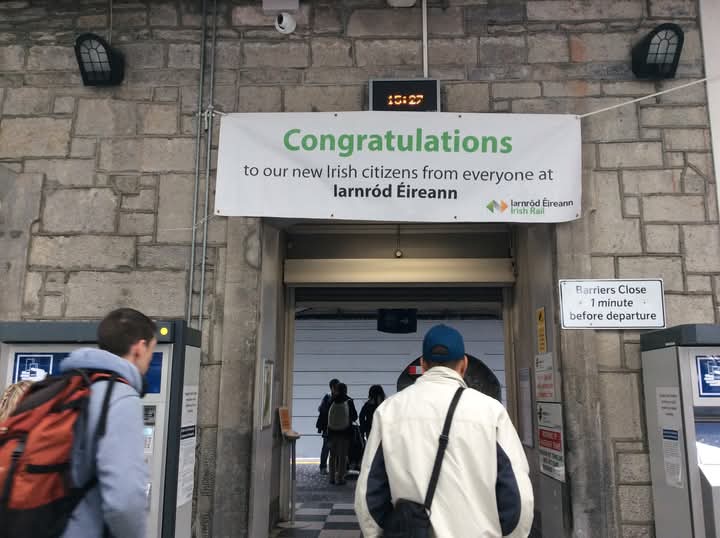
Dublin comes with rain.
You can’t have a country as green as ours without the falling water.
You hear the rain splashing down on asphalt, on the windowpanes of the houses and buses. It’s part of the soundscape and a background track for this city.
Some weeks ago, the sound of the city was the shouts and chants of people demanding that migrants like me, go home! The protesters carried banners of anti-migrant poster boys, like the Presidents of the United States and Russia and an Irish marital artist, recently found guilty of rape.
Some of the protesters carried crosses, even though St Patrick himself was a migrant. As was Jesus.
Some of the protesters wish to go back to a time, before the migrants came to this rock on the edge of the Atlantic. They long for the 1980s, which was a decade of famous tranquillity, fairness, equity and justice. They believe there were no house shortages or unemployment in the 1980s. Their memories state that Ireland was a heavenly garden of Eden, with no addiction issues or poverty, in that special decade.
Some of the protesters wish to go back further.
They liked it better when nice, white, Irish women and nice, white, teenage girls could have nice, white, babies with Irish men. No abortions, no trans rights, no mixed-race children!
I’m not going to listen to their sounds anymore.
I’m not going to listen, anymore, to such words of people, who tell me that their Aunt Mary-Kate went on the anti-migrant march but isn’t anti-migrant.
Aunt Mary-Kate can go and fuck herself!
I can’t be arsed making excuses for Aunt Mary-Kate anymore.
When did it become my job to explain to Aunt Mary-Kate that the engine room of this republic is staffed by migrant workers? Without us you can close the creches and the cafes and the care homes. Don’t try and use public transport or taxis without the migrant workforce. Good luck getting your takeaway prepared, cooked and delivered to your home, and don’t be surprised when hospitals can’t function, without migrants like me.
It’s not my role, to highlight the irony to Aunt Mary-Kate, of this country’s history of migration. Will she bring new posters to the next march, that say, “Stop the Norman Invasion!”, “Vikings Go Home!”, “Irish Diaspora Return – NOW!”
And where does she want us to go, this Aunt Mary-Kate?
We can’t go home, when we are home.
I became Irish seven years ago and in my citizenship ceremony, retired Supreme Judge Brian McMahon, told us that we were as Irish as anyone born here.
But you can’t say this to Aunt Mary-Kate, who thinks that facts are fake news, and that discourse and debate are methods to silence her right to free speech. You can’t use reason and rationale with someone who puts their fingers in their ears and shouts back, “this new way isn’t fair!”
The sound of Dublin is rain, and laughter and stories, within the craic agus ceol. But the sound from O’Connell Street, that day frightened me. They hate me because of the accident of my birth, not because of my own hatbox of contradictions and sins, but they pre-judge me because of where my parents had unprotected sex.
It chills, me, this sound of people who hate me. The sound is so menacing and so large. And so I become quieter.
We’re an orchestra of correlated mammals in a unified living system, and so with a deep breath, love and wide-open kindness, I come back to Aunt Mary-Kate and I try to explain again.
Perhaps this time I whisper.
Our synchronised sounds can be beautiful flute music, or hellish discord.
Even the older trees have memories and want to live well.
The robins bathe, at sundown so that their feathers can make the flight, and we are alive now.
The staggering pain of this life is only balanced by its incomparable beauty and joy. The open secret, if there is one, is to experience both.
Yes, there is both.
 Shorter than me