Tag: book-review

  • Book Review:  Leaflight Moon by Monica Corish

    I first met Monica Corish in the old Irish Aid Centre at the top of O’Connell Street, Dublin, back in the summer of 2012.  She was facilitating a creative writing workshop for returned volunteer development workers, and I loved the Amherst teaching method she used, and the lovely tone and style she applied to it.  I left the workshop thinking, “that went very well”, and we started it then.

    I attended many of her workshops after that.  I went to more sessions at the Irish Aid Centre, then at the Comhlámh offices on Parliament Street and later again, online.  I met her creative partner and partner in life, the writer, Tom Sigafoos and I enjoyed learning from her.

    I always loved her poetry.

    Her beautiful, “Slow Mysteries”, (2012, Doghouse), is a sublime collection of poems about Monica’s home, “and where are you from, and who are your people?”  and Monica’s travels, both in and outside of Ireland.

    In, “And yes, the waves were sparkling”, she takes us to Donegal Bay where the sea was “the happiest bluest turquoise/ I had ever seen” to Ntarama, Rwanda to witness “our own unbearable grief/ for the loss of unbearable joy”.

    It’s testament to her skill as a writer, and creative coach that she can lead the reader safely through difficult terrain.  And it’s those guide-like ways that have come into their own in her debut novel, “Leaflight Moon” (2025, Púca Books).

    “Leaflight Moon” is a story of Sligo, Ireland in 4000 BC, when our ancient hunter gather-ancestors, met the first farmers, who cut down trees and kept their animals in cages.  It’s an extraordinary tale and it’s a wonderful story.

    At first, this period of time, might be disorientation for readers without knowledge of prehistoric landscape.  But what Monica does, and where some of her magic lies, is she treats her characters from six thousand years ago, with the same respect and dignity as she might new friends from the coffee shop, from across the street.  She assumes they have desires and fears, and she gives them voice, through her poetic prose.

    Monica describes the landscape of the time beautifully.

    “The waning-crescent Moon moved slowly through a cloudless sky.  The sea was perfectly calm, the horizon straight as a reed.  They paddled past mountains – WolfHowl – Eyrie – Blade – Boar – all leafing green and speckled white with sloe thorn”.

    Monica’s characters, who change names as they grow and learn more about the land, and their place in it, are fully capable of making mistakes, doing terrible things and learning from their tragic errors.  Monica takes the reader by the hand and whispers, “I know this is a bit unusual, but I am a storyteller and a poet, and you can trust me.  If you stay with me, I’ll show you a story as ancient as the moon”.

    Some of her characters have issues with the newcomers, and their modern ways of doing things.  Some of her characters fall in love, and experience pain, grief, sorrow and loss.

    One of the interesting aspects of the pages, is how characters can sound so reflectively modern, without us suspending our disbelief.  The assumption that they couldn’t possibly be as thoughtful as we are now, is removed, as it is their relationship with the land, the seasons, the animals and of course the moon, which leaves us lacking.

    Whoever, “us” is.

    Change is inevitable in this book and the desire for our species to adapt is essential if they, and we, are to survive.

    “Leaflight Moon” needs concentration, in a world where our concentration is sold to the highest bidder. The reader has to orientate themselves in an unfamiliar setting and Monica is there to help us.  Characters change names just as we are getting to know them, and we need to adapt if we are to keep up.  Why shouldn’t our ancient ancestors get the attention they deserve as we sit around our virtual fires and listen to the stories under night fall?

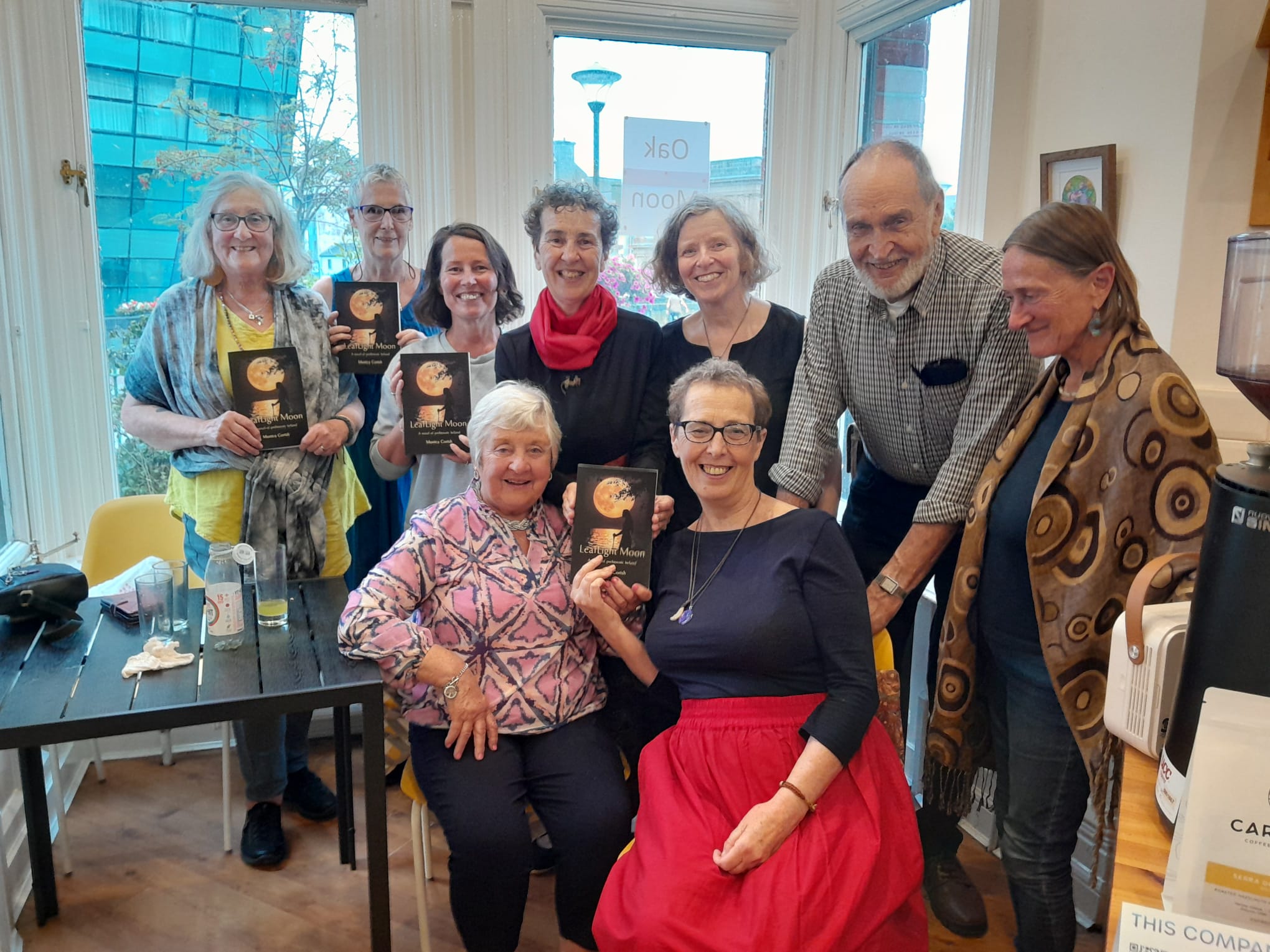
    I was lucky enough to go to the Sligo launch of “Leaflight Moon” and was delighted to meet so many alumni from Kimmage Development Studies Centre, where so many volunteer development workers studied either before, during or after their overseas work.  And of course, the Yeats Centre, where the book was launched, was full of Monica’s supporters, friends, family and other story tellers.

    I was then later delighted to hear that “Leaflight Moon” won, the Carousel Aware Prize (CAP), award for fiction and the Golden CAP for best independently published books, at the award ceremony in Chapters Bookstore, on 10 October, 2025.

    Monica is a poet, creative coach, teacher and friend and now she is a successful novelist.   She has done so much, over the years, to support other writers through her writing circles, workshops and mentoring.  Her warmth and wisdom deserve the success she is having with this book, and I hope she is enjoying every moment.

    Much love Monica,

    From Ruth, Dublin.

    You can buy copies of Leaflight Moon in Chapters Bookstore, and Books Upstairs (Dublin).
  • Review of the International Dublin Writers’ Festival

    My friend, Katie Moynagh, was the one who told me all about the International Dublin Writers’ Festival, and so it was she who called me to the adventure.  Katie writes beautiful poems and short stories, and I enjoy listening to her read them aloud, and I trust her opinions on all things literary.  All the same, I declined at first, as I had other plans for that weekend, but as things moved around and I adjusted my diary, I found myself in attendance at the festival, at the Academy Hotel, just off O’Connell Street, in Dublin city.

    As soon as I arrived, I felt the fear.  What on earth was I doing attending a writers’ festival in Dublin?  I wasn’t established, successful, well read or reviewed.  I like to write, of course, I do, but what did I think I was doing? 

    I met Katie in the foyer.  She smiled, and said she was happy to see me, and suddenly I felt better.  It turned out, no one minded at all, about my status or lack of it.  In fact, everyone was far too busy having a great time, to worry about my worries, and soon I didn’t worry either.

     There were over 20 presentations over the next three days divided loosely into the creative inspiration of writing, and the business of writing.  There were presentations by writers, publishers, agents and companies offering help to writers.  The Irish Writers’ Union of Ireland were there, talking about their “Grand Theft Author” campaign, which tries stop Artificial Intelligence (AI) from stealing writers’ work.  There were Hollywood screen writers, and a member of the Ottoman Imperial Family.

    There was even an improvisation session.

    Some writers read their pieces aloud in an open mic session, and I enjoyed hearing Katie read again.  Some writers got to pitch their ideas for books and plays to our new friends from Hollywood, and after the scariest 90 seconds, received constructive feedback.

    If there was a dark cave, during the weekend, it might be my reluctance to monetise my hobby of writing.  I love writing.  I’ve always loved writing.  I love my daily practice of trying to put into word form, the experiences of being in this world.  I try to connect, with my honest, messy and incongruous inner world and try, if I can, to make sense of it.  The idea of selling this seems ugly.

    And yet, of course, I would. 

    In a heartbeat, and a nano second and without asking any questions.  Which is why I joined the Irish Writers’ Union of Ireland, so that if I ever did get a book deal, someone would read my contract for me and tell me if it was safe to sign.

    As well as joining the Union, I bought some books.  I made some new friends, and I absolutely adored being surrounded by writers, and people who love the business of writing, for the whole weekend.

    I really thank the lovely organiser, Laurence O’Bryan and his team at Books Go Social, and I look forward to seeing everyone next year.

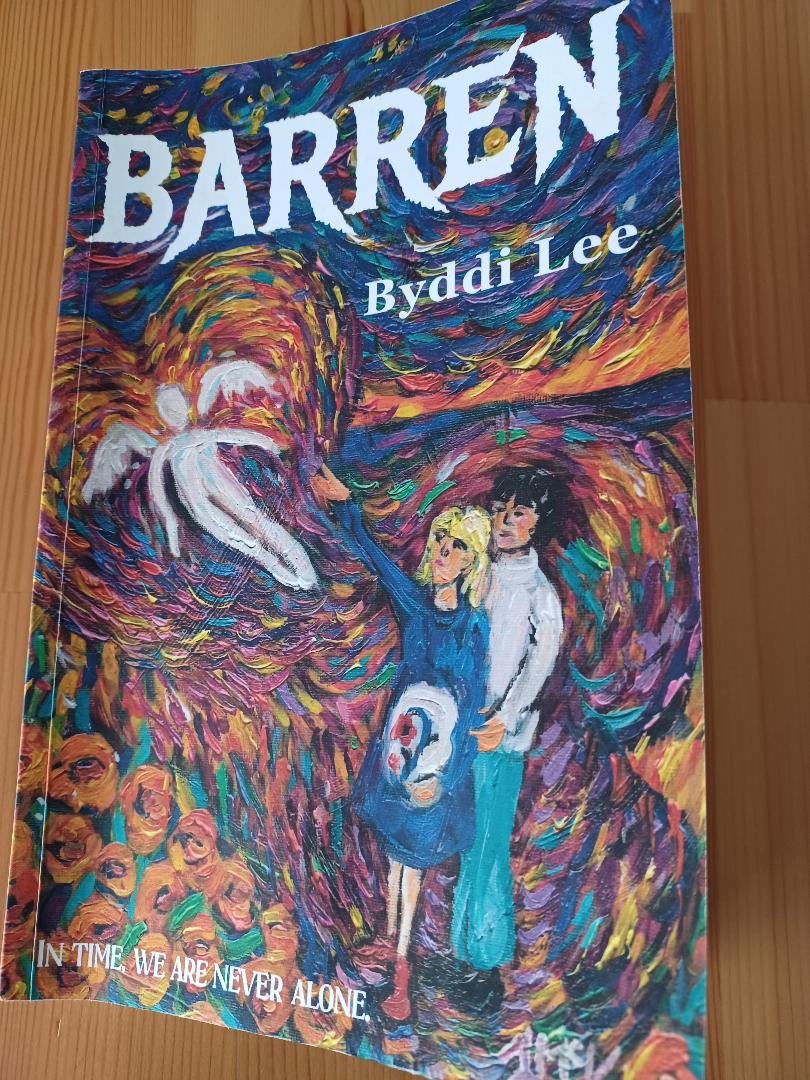
  • Book Review:  “Barren”, by Byddi Lee

    Byddi Lee’s “Barren” is a book about loss, sorrow, love, and hope. 

    “Barren” is an original story about two women separated in history by 4000 years, and connected by spirits, colours and auras.  It’s beautifully written, very funny in parts, and structurally very satisfying as both women return to an axe, and to the foundations of their stories.

    Aisling lives in modern day California, and together with her husband Ben, is Trying to Conceive (TTC).  Childlessness for both, but particularly for her, is a barren landscape which is becoming more expensive and challenging to their relationship.  The external pressures the couple face are the effects of climate change and a profound homesickness, which eventually takes them back across the Atlantic to visit Ireland.

    Zosime, meanwhile, lives in Ireland in 2354 BC, and faces the loss of her village.  A comet has passed too closely to the earth, and the sun has disappeared.  Zosime’s communal loss, her need to “follow the sun” and journey towards the sea, and beyond, is a challenge that she and her partner, Nereus, learn to manage because of their intrinsic hope.

    The two parallel stories are connected through plot, colours, prose and humour (one section ends with a ritualistic ceremony involving dead pigs, while another section opens with the couple in California cooking a fry!).   And as the two women slowly realise that they are stronger and more capable than they might have imagined, they also start to realise that their own stories can change, and the stories they witness carry their own energies and auras. 

    “telling our story, and bearing witness to others’ stories…”

    The juxtaposition of a very modern, realistic story of two Irish people living in California could be jarring against a neolithic story of hunter gatherers forced from their village, and yet, Byddi Lee manages to take the reader through the landscapes safely.  There are moments of magic realism, simplicity and dreamscapes, set against a backdrop of climate chaos, forced migration, deep sorrow and healing.

    Byddi Lee has a history of taking care of stories and the stories she witnesses.  She is the founder of, and she manages Flash Fiction Armagh, where she promotes new writers, sometimes in the Armagh County Museum, which makes a visit in the last few chapters of “Barren”.

    Already described as, “engrossing, immersive and wonderfully constructed” by Donal Ryan, “Barren” is beautifully written, enjoyable and poignant, with great hope and love on every page.

    “We don’t come from nowhere, nor do we vanish into nothing.  I always knew three facts.  I was wanted – in bright shades of flashing yellow – desperately wanted. I was loved – in vibrant shades of swirling pinks and reds – unconditionally loved.  And I’d never be forgotten – in shimmering waves of silver – always remembered”. (p.12)

  • Peaceful warrior

    Peaceful warrior

    Recently, a stranger started to speak to Grace in the arrival’s hall of terminal two, in Dublin airport.  She was waiting for a cousin to arrive in from Edinburgh, and a man began a conversation about time.

    How funny it was, he said, that when people are waiting for a plane to land, time slowed into infinity.  Yet, no doubt the time spent with the people on the plane, would speed up exponentially.  The man cited an article he’d read lately, about how it was possible to control the perception of time.  All you had to do, he claimed, to slow down the perception of time, was to find something novel and fulfilling in each and every day.

    “Like this conversation?” asked Grace, and the man laughed loudly and said, “yes, exactly so”.

    They talked about technology and how detailed the airport information was compared with years earlier.  Nowadays, the large overhead boards told those waiting when the plane was approaching the airport, the moment of landing, when it was taxing to the gate, and when exactly the passengers had officially landed.  The man and Grace didn’t know, however, what to do with this extra information, or the moments of time gained.

    Were they to split the second?

    Grace was meeting a cousin she hadn’t seen since childhood and was both excited and nervous about the weekend.  When she was a child, Grace spent time visiting her cousins on a farm near Ross-on-Wye.  Her three older cousins seemed to Grace to have an idyllic existence with their dogs, chickens, sheep, and ponies.  The cousins always smelled of earth and came in enormous, warm, cosy clothes that were so well lived in.  Grace was meeting the eldest of the three sisters, at the airport.

    One time they all went to Tintern Abbey to see the ruins and they took a picnic, a flask of hot tea and a blanket to sit on.  The cousins, used to wide open spaces and running, grew tired and restless and started a game of hide and seek.

    Grace ran as fast as she could and hid between the gravestones, far away from everyone.  She huddled down beside the grave of a man who had died in 1732.

    He died when he was 34 and was missed by a loving wife and eight children.  Grace wondered if this man liked music if he played the piano or sang?  This fellow, this dead fellow, did he play hide and seek with the children, or was he too serious for games?

    Did he laugh and look at rainbows with such awe it made it want to cry?  Did he dance every chance he got and marvel at the extraordinary brightness of colour?  Did he lose sleep with worry about his eight children, his wife, the harvest, and the rain?  And did he, at times, realise fully that the best way through his short life, was to be a peaceful warrior; to defend himself fully, while not ever causing harm to any other creatures?  Did he wonder about the particles of atoms into the otherness of eternity.

    Did his children make him laugh; and did he ever save some time?