Blog

  • Other Swimmers

    water

    I like to go swimming from time-to-time, and my nearest pool and leisure centre is in the heart of the city.  I’ve never been a member, I don’t have that level of optimism, I pay as I go and sometimes, I go before work. Every time I do it though, I wonder if my main motivation might be so that I can tell friends and colleagues about it afterwards.

    “Wow, I went for a swim this morning, I feel incredibly alive and alert.  It really sets you up for the day!  Just going to eat my vegan-friendly-flapjack, now, with my fresh kale and orange juice.  Hashtag blessed”.

    There is a self-selection lane system in our pool and you can choose between the fast, medium or casual lanes.  I always go in the casual lane because I like its name and the idea that there’s no real commitment.  Any minute, I might join the Pilates Class over in the studio, or even take-up Tai Chi.  A lot of people drastically over or under estimate their ability and efficiency in the water, and that’s when the lifeguards have to step-in.  I notice that it’s always the men swimmers who need to be demoted slightly and the women promoted up a lane or two.  I don’t know what that says about our society, but it says something.

    It surely says something.

    There’s a woman in our pool who wears a Wonder Woman swimming costume, complete with matching silver swim hat.  She’s definitely in her 40s, and sometimes I want to speak to her and ask her a load of questions, such as, what she thinks of the new Wonder Woman film and if she believes it’s a successful re-working of the feminist hero myth or not.  But it’s hard to do that when you’re doing laps.

    There’s a man in our pool who doesn’t swim at all.  He just walks out as far as he can, until the water is up to his chin, and then he turns around and walks back again. He repeats this many times, but that’s not even the unusual bit.  The whole time he’s walking through the water, he’s talking.  Talking aloud!  Seemingly to himself, because no one is listening.  When a new swimmer comes into the pool area, this guy welcomes them, as if they’ve just arrived into a Hollywood 80’s pool party.

    “Hi there Harvey, haven’t seen you in decades, come on in, the water’s fine”.

    Harvey, or whatever his name actually is in reality, typically hurries into his chosen lane and starts swimming quickly, without making eye contact.  Swimmers are shy sometimes, I notice that.

    There’s another one I watch and am intrigued by. He’s the one I call “Glasses Man” because he wears his eye-glasses in the water.  I could understand that, if you were taking it easy and doing a bit of breast stroke over in the casual lane, but this one always goes into the fast lane, and puts his head right under the water.

    There’s this Brazilian couple who like to walk around the edge of the pool, kissing and canoodling, hand-in-hand.  It’s like they think they’re on vacation at the Copacabana and I half expect them to wave at me.  There’s a woman in a white and blue daisy swimming hat, who swims on her back, and sometimes hums along to the songs in her head.  She splashes and flaps around like how I imagine Zelda Fiztgerald might have swum.  In the sea, in the south of France.

    There are people who use swimming aids, and they are fascinating to me.  Now I fully comprehend the need for floats and adult arm-bands, especially over in the casual lane.  We can all swim over there of course, in the sense that technically we don’t drown, but none of us are likely to be Olympic medal winners in the next little while.  But some people bring flippers, I mean really.  Flippers are part of diving gear and they have no place in the swimming pool!  There’s this one guy in our pool, who flies up and down the fast lane, and I feel like saying to him,

    “Hey flipper fella, you’re cheating no one but yourself, how about taking those flippers off and seeing your real life speed instead?”

    But I never do.  Like I said, it’s hard to speak when you’re swimming.

    Some people do a complicated stretching routine before-hand, and bring litres of juices and coconut water to re-hydrate between laps.  While at the end of the spectrum there are those who do so little, you wonder why they just didn’t go to the coffee shop instead and have a giant cream bun and a hot chocolate.

    The last time I went to our pool, “Glasses Man” was evicted after causing a pile-up in the fast lane.  He started shouting “you can’t make me, you can’t make me leave the pool!” and everyone was staring at him.  All of a sudden Walking Swimmer joined in, and started yelling from the other side of the pool to the lifeguard, “that’s right Paul, or Tony, you can’t make him move, this is his pool as much as anyone’s!”   And for a moment it seemed like Wonder Woman was going to say a few words too, but in fairness she was in the middle of a tricky set of Butterfly, so couldn’t really get involved.  In the end, Daisy Hat Woman started singing the French National Anthem, and I don’t know why, but that seemed to calm things down.

    Glasses Man left the poolside and we all went back to our breathing and our own technique.  We listened to the silent emptiness of underwater swimming strokes, and we finished our laps.  We concentrated just on the rhythm of the pool water, and the unique sounds of all the other swimmers.


  • Curator of Lives

    On the day before I flew to Togo, I saw two Franciscan monks sunbathing.

    They were sitting on white plastic chairs, and the heavy white cotton of their habits collided with the soil.  Like fish who can’t see the water around them, the monks didn’t notice me watching.

    I think I might have heard the monks chanting “Praise be you, my lord, through sister moon.  And the stars, in heaven you formed them.  Clear and precious and beautiful”.

    The day after I flew to Togo, two football teams stopped their game, to allow our mini-van to drive over their red-earthed pitch.  The dust and the heat and mosquitoes didn’t take a short pause though, on that day in Lome, in the spring.  It was the day that Judith took me to get my new visa.  When we crossed the road, she casually linked arms to guide me through the traffic and I admired the simplicity of her kindness.  I needed a new passport sized photograph, and she wiped the sweat away from my forehead, with some tissue from her bag before the picture was taken.    An uncomplicated decency, a fluent courtesy.

    And like fish who can’t see the water around them, she didn’t notice me see her.

    On another day, we went to Agbodrafo, or the “House of the Slaves” and the curator of the museum walked us around.  Thousands of men, women and children were stored there before being shipped-off across the Atlantic for a lifetime of slavery.  The curator showed us the room where the people were bought and sold, and the cellar where they tried to sleep.  To distract me, I thought about the orange tree in the garden, and how sweet the scent was.  I wondered if the people had breathed that same flavour in?  If their last memory of home was of an orange tree?

    And like fish who can’t see the water that surrounds them, the curator didn’t notice my grief.

    Later that evening over dinner I asked Judith more about Agbodrafo, but she was busy greeting the guests, and overseeing the platters of fish.  Even though it was her birthday, her main ambition and desire was to secure everyone else’s comfort first.  And she had no interest in discussing orange trees.

    The evening I flew home from Togo, I noticed the moon.

    It was a midnight flight back to Paris and the moon was a beautiful, white, full-one, which shone and showed us the way home.   It guided us away from Judith and Agbodrafo, and from those boys still playing football.

    All the way back to the place where the Franciscan monks might still have been singing:  “Praise be you, my lord, through sister moon.  And the stars, in heaven you formed them.  Clear and precious and beautiful”.

    agbodrafo2


  • No Reading in the Library

    water

    It all started when the Head Librarian put a notice on the wall, which said “No Loitering in the Library” and we all thought it was a good thing.  Jenny-Ann, Stewart, Em Em and I had noticed that the wrong type of person seemed to be hanging around our library.  That type that will just sit around on the big oak table, reading the magazines, checking the free internet.  That type that might not even know the difference between a metaphor or a simile, the type that can give a small well-run-community library a bad name.

    Jenny-Ann, Stewart, Em Em and I are the working committee for the Contemporary American Literature Book Club that meets every Tuesday lunch time.  In order to organise the book club, the committee has to also meet every Wednesday and second Friday too, because as you can imagine, there’s a lot to do.

    So when we first saw the “No Loitering in the Library” sign, I said to Jenny-Ann “well I for one welcome that sign” and she said “it didn’t come a moment too soon”.

    Our committee has been through a lot of changes of late, no one could deny that.  Ever since Jenny-Ann and Stewart got divorced, and Em Em put on all that weight again, things have been strained.  I’ve been trying to guide our ship through quite some choppy water, I can tell you.  And I don’t always feel fully supported in my role as Acting Chairperson either.  Em Em is so depressed right now, and Stewart is a shadow of his former self.

    And then they put up another sign.

    The second sign told library users that CCTV was now in operation, and again our first reaction was that this was a good thing.  In fact, it brought us all a little comic relief after all of the tension, because Stewart made a joke about the CCTV.  He said “imagine if they filmed someone stealing a book from the Old Norse Section.  And then imagine that the police caught the thief by tricking him into confession, by asking him a question in modern day Danish!”

    Em Em and I laughed at that idea for ages.  We always found Stewart very witty.

    But then Jenny-Ann said that Stewart had always had racist undertones when it came to the Scandinavians, and that his insinuation that the thief had to identify as male was sexist.  And then Stewart said that Jenny-Ann had always been a manipulative, judgemental cunt and he wished he’d never met her!

    Well things just went from bad to worse then.

    Em Em got so upset, she left without even proof-reading her review on the latest Franzen novel.  And I resigned from my role as Acting Chair.  The group disbanded and then one Tuesday I came into the library to see a sign that said “No Reading the Library” and so I handed in my library card, and I left for good.

    I go swimming on Tuesdays now, and I don’t miss that place at all.


  • Too easy to finalise, (or companion piece to “Turbulence”)

    room_view-1

    Everyone wants a pretty eulogy.  They want a happy-ever-after that does not involve a misspelt tattoo or a death due to a selfie stick.  The people who designed and built the Duomo wanted to be remembered well.  But the rest of us don’t want to be overlooked either.

    “That’s all very interesting,” said Alice “but what are you going to do about Harris?”

    “Harris?”

    “Harris Blakely, who is sitting in seat 7G, on flight FR1977 from Riga to Dublin?  You’ve forgotten all about him haven’t you?”

    “No, I just…”

    “You just what?  You left him there on that plane with only a glass of white wine and his thoughts for company.  Are you going to leave him there, indefinitely, flying around in the turbulent sky, with no hope of denouement?”

    “No, I just…”

    “So what are you going to do with him?  Maybe it was all a dream or the wink of an eye of a rabbit in a well-kept garden in Connecticut?  Something has to happen to the man.  A plane crash perhaps, although that’s very melodramatic and expected, perhaps then a sense of unease or a realisation of sorts, a moment of unexpected joy even?”

    I didn’t reply.

    I thought about Harris.

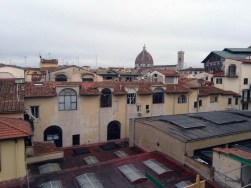
    He was being seduced by a memory of his early years with Rachel, when they first fell in love.  The memory came into his mind with the radiance of a new emotion, as if it were the first time the event was happening to him.  He remembered a short holiday in Florence, when they were first together, and yes, that’s right, there was a thunderstorm.  He and Rachel had been out all day and were exhausted, so they stayed in their room to enjoy the storm’s spectacle.  They were drinking Peroni from the bottles and they couldn’t believe the view they had.  This was just a cheap little hostel, but it came with that view.

    Some view.

    They kept the green, wooden, bedroom shutters open, and marvelled at the light show nature was putting on for them.  Occasionally, they would tip toe outside to the balcony for cigarettes, but they mostly just lay on the bed, talking until the sun came up.  Retaining that memory for Harris, was as comforting as melted butter on toast, from an open fire.

    If the truth were known Harris was enjoying this peaceful time on the plane.  He rarely spent any time alone so he was quietly delighted that Rachel was sitting a few rows behind him.  It was relaxing.

    He knew that his marriage was ending, and that they were both simply too polite to end it.  They were tentatively walking around the corpse of the relationship, but it was starting to smell, and someone was going to have to mention it.  He should do it, and as soon as they got home to Dublin, he would do it.  Yes.  If he took control of this, it might be easy to finalise.  With the decision made, he felt much better and even the turbulence now didn’t disturb him.

    Rachel remembered the same night of the thunderstorm in Florence too.  But it was with sadness that she thought of the end of their marriage.  Perhaps it wouldn’t end quite yet, perhaps they would have another holiday, or another Christmas, surely it wouldn’t end in the nearest of futures.  She had loved their lives together.  She had loved the time.

    When the most attractive of the cabin crew offered Rachel a drink, she shook her head.  She had stopped drinking six years ago so it was hardly a temptation anymore. Rachel was also enjoying sitting alone without Harris.  She tried to read her magazine, but it was futile with the turbulence, so she drifted away from thoughts of dead relationships, and onto living stories instead.

    Rachel liked to make up stories for her young students.  One particular group, who were having a hard time with the literature on the curricula, loved to hear the stories she created, and so the deal was this:  Rachel would tell them a story at the end of class, but they had to summarise it “in their own words” for homework.  Before the short mini-break to Riga, the girls had been enjoying one called “Floatation”.

    Three people lived on Floatation, and they all had very different jobs.

    Sujilth was the swimmer, and it was her job to swim out from Floatation every morning to collect debris or living fish.  Debris included old bits of wooden furniture that hadn’t eroded yet; a photograph, pieces of plastic and the occasional piece of jewelry.  While Sujilth’s main job was to collect living fish, she enjoyed the debris more, so she left Floatation early every morning and she swam back home before the sun went down.

    Sujilth always gave the debris to Grandfather to catalogue.  He named the things, told her what they had been used for Before the Final Flood, and kept them for safekeeping.

    “People will want a record of what happened before” he would say, but she wasn’t sure.

    Why would people would want a record?

    Which people?

    They used to see other people, and other Flotations quite often, but they hadn’t seen anyone for four full moons now.  She knew also that there were less and less living fish, and that Xeros was nervous.

    Xeros was a boy, perhaps the same age as Sujilth, but taller and more beautiful.  He had a long neck and long toes, and she admired him.  He had much nicer skin than hers, because he didn’t go swimming so it wasn’t all crispy, but she was better at counting.

    Every day she took the living fish back to him and he would decide to either cook them or else keep them in the clean water tank.  Breeding and barbequing fish were his obsessions.  She didn’t like it when he was angry about the lack of fish she caught, she preferred it when he kissed her and told her that she was beautiful too.

    Yesterday, Sujilth brought back a plastic bag, some diamonds and another telephone.  Grandfather laughed and tried to explain that Before the Final Flood, the telephone and the diamonds would have been the most valuable of the three finds.

    Now he just needed the plastic bag, to collect the rain, should it come again.  Or to burn it for a fire.

    “Tell me more about the telephones and the diamonds” Sujilth asked, as she loved his stories at the end of the day.  But Grandfather was tired.  Xeros didn’t want to be distracted either as he was cutting the fish and removing the skin.

    “Please tell me more…” she said, “tell me more”.

    Grandfather said “I would love to, my sweet thing, but do you know that my memory is less reliable than melted butter on toast, on an open fire”.

    “I long to tell you more about butter and ice-cream and chocolate sauce and pineapples.  I would give my soul to hear a dog bark in the night time or the sound of  a door closing.  I’d like to hear a church bell or even the sound of an ambulance would be nice.  I would like to feel something instead of floating.  Something solid and still instead.  But we need other people, we need other fish”.


  • Even more…about the other side of Donnie

    cinchilla

    Many of you will remember the blog I wrote, in which I tried to encourage you all to see the other side of Donald J Trump.  I wanted you to look at him through a telescope of fairness, objectivity and possibly even kindness.  Many of you will also remember how I suffered because of the special relationship I have with the 45th President of the United States.  And many of you will indeed remember how I lost my job, my long term partner, and many of my friends when I went public with my thoughts.

    Well let me just tell you right now, it’s been a nightmare of a witch hunt!  I am still in hiding in a secret location in Kilkenny, and I’m at the end of my tethers.  I can’t even show myself at my Bikram Yoga class, let alone Spinning.  Yet, despite all of the sorrows, I’m still pleased I said what I did, and do you know what, I have even more to say about the other side of Donnie.

    Donald John Trump was born on 14 June in 1946 to Fred and Mary-Anne who were, like all new parents, just thrilled.  Only a few hours after his birth, however, Mary-Anne suffered excruciating postnatal depression, which manifested itself in the most unusual way.  Mary-Anne thought Donnie was a chinchilla and refused to have him in the home with his other siblings, so he was sent to live with Uncle John Trump, who was a professor at MIT, and all too keen to study the young baby.

    Professor John put baby Donnie in an enclosure in Boston Zoo with a few lemurs and a family of sloths, and the young boy spent the first seven years of his life, essentially living with primates.  It was Professor John’s idea that Donnie would be able to educate the other animals.  Well of course, what happened was, that it was they who taught Donnie how to act, rather than the other way around.  So, Donnie spent his first seven years eating, grooming, sleeping and playing with the other fury creatures, essentially acting like, and thinking he was, a chinchilla.

    Well you can just imagine what this would do to a small boy, I mean really the poor thing!  The first seven years of his life, can you just imagine that?

    On his 7th birthday Mary-Anne went to see him at Boston Zoo.  She took the other children and she thought she would make a day of it as she was hoping for a family portrait.  However, when she saw him she was so shocked by how like a real chinchilla Donnie was acting, that she demanded he be released into her care immediately.  She took him right home, and started to look after him, as mother should.

    When Donnie first moved back into the apartment in Queens, with Fred, Mary-Anne and all the other Trumps, there was a transitional period where everyone had to get used to him.  Obviously, he couldn’t go to school, the child wasn’t even house trained at this stage, and he still liked to climb up the curtains, so Mary-Anne suggested that he might like to take up professional wrestling and she enrolled him in a local gym.

    At the beginning this worked out very well for Donnie.  He loved the physicality and freeness of the sport, and he quickly learned his new craft. The gym guys liked him and he picked up English quite quickly and he slowly put away his chinchilla habits.  He started eating at the table, sleeping in a bed at night time, and he controlled the jumping.  By the time of his eighth birthday, he was acting like a real boy and ready for his first live evening fight in the ring, with an audience and everything.

    Sadly however, on the evening of the fight, he registered his wrestling name as “Kleine Kaninchennase” out of respect to his Germanic roots.  He thought the name meant “German Menace” when it actually translated as “Little Rabbit Nose”, so when he went into the ring he was met with laughter and taunts from the audience.  “Little Rabbit Nose!” they shouted “Little Rabbit Nose!”

    Remember this was back in 1953!

    Well I mean this just brought back all the memories of the primate enclosure right back to him.  All the work at the gym, with the wrestling and language acquisition and toilet training vanished, and this little boy, who was still only eight years of age, was now permanently damaged.

    He would never be the same.

    So I don’t care that the public doesn’t understand me!  I have empathy for that little boy who grew up to the be the 324th richest man on the planet.  Money doesn’t replace a mother’s love, or peer support, or going to school with the other little boys and girls.  Money can’t buy love and my hear just bleeds, when I think about the other side of Donnie.

    It just bleeds.


  • Taliswomen

    mangrove
    Photo by Kristel Kallua

    Ho Chi Minh City is filled with motorbikes, street vendors, Pagodas and noodle soup.  From the skyscrapers, you see its urban residents move up and down the allies, across the rivers and through the parks.  Ho Chi Minh City wakes up early and doesn’t stagnate until late that same night.  Ho Chi Minh City sleeps lightly.

    But I’m not there now.

    I am on a floating house in a mangrove forest, where monkeys steal food and pigs run between trees.  A rooster crows.  The river is so low that my floating house rests on the muddy, soft, riverbed, while crabs and lungfish fight over the insects remaining.  By night, the tide will be high again, elevating my house up higher while the roots of the mangroves will protect the village inland, from the sea.

    And I am not there now.

    I am on a sampan on the Mekong Delta and we are moving slowly.  The stroke of the single oar fractures the silence, and no one can see us.  Not long after, I am in the vicinity of sleep in a hammock on a salt farm.  Filled with fish and rice wine, it is too hot to be outside, so I rest here while the owner of the household smiles on kindly.  She finds my tiredness entertaining, and she is happy I enjoyed the lunch.

    I am there now.

  • There is only now

    At the Darsena beach café bar, there is only now.

    A white tipped wave comes up to the sand and says…“I’m sho shorry, did I dishturb you?”…but you shake your head twice at him.

    If you had more energy you would wink.

    Your head lies in the water and your hairs float towards the horizon like tentacles of an octopus.  You feel the ambrosial warm water pulling you.  A grey fish lies near you.  He’s too dead to throw back in the sea, but you notice his one gill is moving.

    His Picasso eyes stare at you, but there is nothing now, at the Darsena beach café bar.


  • The other side of Donnie

    one-ger

    All eyes were on my social media platforms last week when it emerged that it was I, Ruth Powell, who was the mystery, long-standing, close friend and advisor of Donald Trump, President-elect of the United States of America.  When the details of our close intimate friendship were leaked to the public, I had to leave my apartment in Dublin and hide out in a B&B in Kilkenny.  Friends, family and people I have never met said that they were “outraged”, “shocked”, “numb” and “in pieces” when they heard about the relationship.  Only one woman from Donegal commented that she felt “peaceful”.  Of course, it later came-out that she was actually responding to a posting of mine on the ancient Japanese art of Shirin Yoko, or forest breathing; so she re-posted her comment again with the words “peaceful, my arse!” just to clear things up.

    Many couldn’t believe, that I, Ruth Powell, long term development worker, teacher and friend of the oppressed, could have been hiding my relationship with a man that so many feel contempt for.  Well let me just say a few things from my point of view and dispel many of the evil myths and lies that have been circulating around this story once and for all.

    Let me just tell you all about the other side of Donnie.

    I met Donald Trump in the autumn of 2006, that part is true.  But we certainly did not meet at a Halloween themed party at the Playboy Mansion.  I’ve never even been to California.  No, Donnie contacted me when I was working as a VSO volunteer in Ulaanbaatar, Mongolia and he asked me if he could join me for a couple of weeks, a month maximum, as he had an interest in working with people from less fortunate positions than his own.  I was surprised at first, but over a few emails I heard a real longing from a lost soul, and I thought, “heck, why not invite him over for a few weeks, how bad can it be?”

    Well let me just say this once, he did not stay in my apartment near the wrestling palace, as has been stated in media!  No sir.  Donnie didn’t want to live in an apartment in town so he chose to live in a traditional Mongolian ger, ten kilometres from the city centre.  He spent his days playing with the children from a local orphanage, working with the local women’s farmer’s association, delivering training sessions to the LGBTQ working group and teaching the homeless how to read and write.  I would visit Donnie in the evenings, and I never saw such dedication to the eradication of inequality.  The man was a beast.  He would stay up all night learning the Mongolian language and practising his throat singing ability, and whenever we finished our dinner, he would take out the left overs and give them to the street children.  He was unstoppable, dynamic, passionate and inspiring.

    After a month he went back to the States, but not until he set up a fund for women from vulnerable backgrounds to set-up their own small businesses.  He also established a library in the university, and presented cheques to local NGOs.  When I asked if I could take a photo of all this great work, he simply said “no Ruth, let’s keep this quiet”.  When he returned to New York he sent me a wonderful thank you letter, in which he quoted Shakespeare and Chaucer, and finished it with an elegant haiku.

    We stayed in touch after that and yes, it’s true that he has asked my advice on a number of occasions.  It was I, Ruth Powell, who suggested he run for President and yes, I was asked for my opinion on his hair-style, clothes, wives and political policies.  But we never actually again met in public, simply via email and Facebook and he sometimes tweets me.

    Late at night, he sometimes tweets me.

    When the story of our decade long friendship broke there were such vicious undertones that I simply had to respond.  Many call Trump a callous, manipulative sociopathic-megalomaniac , but those people never did see him playing barefoot, with the children, under the constant blue Mongolian sky.  Those people never saw him laughing and they simply don’t know Donnie like I know Donnie, and it’s those people that I feel sorry for.  Those people indeed!


  • Turbulence

    turbulence

    “It’s not pleasant, but it’s not dangerous” said the most attractive of the cabin crew to Harris Blakely, who was sitting in seat 7G, on flight FR1977 from Riga to Dublin.  Harris was not a natural flyer, nor was he enjoying this particular batch of turbulence, but he wanted to let her know that he disliked his fellow passengers in seats 7D and E far more than his fear of flying.  Instead, he returned the smile and said “can I have another white wine please?” and the steward nodded.

    The couple in seats 7D and E were obscenely annoying.

    They were young, beautiful, confident and well-dressed and were very much in love with one another.  Harris disliked them both, but in particular the young woman due to her incessant chewing of gum.  He could hear the sound of the chewing, like boots walking through squelshy melted snow, and he could smell each tiny spearmint droplet.  He felt as if he were inhaling her, and it disgusted him.

    The couple had been staring out of the window all through take-off, out over the Baltic sea and towards Finland.  But now they were staring at one another, stroking the others hands and smiling far-away smiles.  Harris took the opportunity to close the plastic shutter on the window.  He opened the bottle of wine and poured half of it into the plastic cup.

    Harris looked behind him to his wife, who was sitting four rows back in seat 15B, and there she was smiling at him immediately, which made him feel as though he were being watched.  There had been a mix up at check in, but Harris didn’t mind the separation of rows on the way home, after the disastrous holiday.  It gave him time to sit alone and think.  He smiled back at his wife and she blinked in return.  When they first met Harris loved the way she blinked, he found it sweet and endearing and amusing, but nowadays he just hated it.  There were times when he just wanted to shout at her to just stop blinking all the time, but he used his powers of restraint and kept his irritations to himself.

    Harris and his wife, the blinker in seat 15B had been in love at the beginning, because Rachel remembered it.

    Rachel remembered hearing about him before they met, and even when they did meet, she heard his voice in the garden before she saw his face.  When they did finally speak, at the end of the sunny barbeque in a garden yard in Rathmines, it took seven seconds before she fell in love with him.  She loved everything about him without a delay.

    He was a little drunk from the wine, and soon he said to her, “I’m going to kiss you now” and she liked it.

    “Now?” she asked.

    “Well either now or not now” he shrugged, so she leaned in close next to him and kissed him.

    But 19 years later and they were nearly middle aged anyway.

    The holiday had been a failure.  While Rachel had enjoyed the walking tours of Riga’s old town and took plenty of photographs of the Gothic and Nouveau Riche architecture, Harris just stayed in small bars and cafés, read his books and ignored her.  She tried local sausage and fish, he ate from McDonalds, she went to folk music and dancing evenings, he stayed in the hotel and watched satellite TV.

    Rachel didn’t mind that they weren’t like the newly in love couple sitting next to Harris on this flight, but she missed the barest of intimacy.  She wanted to see him laugh again, to feel him close again, to hear him say again that he wanted to kiss her, either now or not now.  She missed the physical feeling of love, the sensation of falling, feeling like floating, or like a feeling of turbulence, and she missed the sense of not being alone.

    She just didn’t know what to do to change it.


  • Autumn Falling

    autumn

    Usually, when you invite your friends over for dinner, on an innocent Saturday evening, you don’t expect it all to end with fire engines and ambulances outside of your home.  You don’t expect to see the neon blue lights of the emergency vehicles reflect onto the faux gothic stone work of the church opposite.  You don’t expect it to happen, but it does.

    And at other times, you don’t expect a Sunday afternoon to end with the sight of an old woman falling on the pavement right in front of you.  Her leg bursts open silently and her blood decants down the slope of her shin, like watered down cranberry juice.  She looks at you directly, because you remind her of her niece in Arizona, but her lips have turned blue and she’s afraid.  You don’t expect it to happen, but it does.

    And usually, when your friend from Eritrea, (let’s pretend she’s from Eritrea), calls you up on a Monday, and invites you out for tea, you don’t expect her to ask you to buy a small pill on the internet, which will take the fertilised egg away from her body.  You don’t expect it to happen, but it does.

    You purchase the pill and you watch it travel north from Mumbai towards the small post office in East Wall, through the tracking device on DHL. On the day you go to collect it, the woman there says “mild weather for this time of year” and you smile.  You sit on the bench nearby and hold the package in front of you, and wonder if you’re both plunging into harm’s way.

    But your friend, let’s just still pretend she’s from Eritrea, says thank you and holds your hands tightly.  She says that this autumn is falling into place now.  She tells you that September smells the same no matter what age you are, that it smells of back-to-school leather satchels, coffee and the fragrance “Beautiful” by Estēe Lauder.  She reminds you that no one was hurt in the fire, and that the woman recovered well after her fall.  She tells you that what you are doing is not sinister or toxic, and that everything will be well with this pill.

    She says everything will be well with this pill.