Category: Uncategorized

  • Staying with business

    cambodia

    Earlier this summer, I was resting from the sun in the shade of a bar in northern Cambodia, after a long day of sight-seeing in Angkor Wat.  It was the first day off in what felt like a long while, and I was enjoying the quiet of a beer in a place where fishing nets and wicker baskets were the main decorations.

    I was waiting for my fish and rice dish to come and was enjoying the second drink of the evening, when suddenly, and out of nowhere, I felt contentment rise to meet me.  The unexpected sunset view from the rooftop was pleasing and even the songs on the radio matched my mood.  I started to smile when a woman from across the bar smiled back at me and asked “are you loving my country?”  I nodded and told her that I was indeed, loving it all.

    She said to me “my name is too difficult for you to pronounce, so please call me Suzi”.  And I said “well alright then Suzi, why don’t you sit here next to me and have a drink?”  So she pulled up a chair and she joined me.

    I had been writing in my note book before she arrived and she pulled the book towards her, and read it without asking for permission.

    She read the first two lines aloud:

    “Up close the vision differs, from afar the light reflects.  And my dreams of Kampuchea star monks robed in saffron, a slow journey down the Mekong and poetry and song”.

    She smiled and then asked me “what does it mean?  It doesn’t really mean anything does it?”

    I tried to explain to her that it really didn’t need to, but she only closed up my note book and asked “what is your favourite part about today?  What do you love the most about my country?”  Yet before she allowed me to answer, she asked a further question…

    “…and what is the difference between shadow and shade?”

    I drank some of my beer, put my note book into my bag and thought about the answer.  I told her it was nice to be in the shade on such a hot and humid day.  Bu this didn’t appear to appease her and so she continued.

    “I have a Masters Degree in tourism and business administration, I speak four languages and my parents own a guest house near the river, please note, my business card” and she presented me with her card.  I had nothing to give her in return, but I wrote down my email address on a damp serviette and she looked at it suspiciously.

    She placed it carefully into her wallet and then said,

    “But staying with business, what is the difference between shadow and shade?”

    A series of small ants ran over my feet while a geko performed her acrobatics near the electric light bulb.  The wooden fan twirled while a tuk tuk beeped his horn outside and the moon rose over another evening in the north of Cambodia.  As I looked down onto the street, I saw a woman throw a basin of dirty water into the gutter, a dog bark at a child who was running, and a motorbike ride on the pavement.  The sweat of the evening drifted down over my neck and shoulders and into a lake on my back.

    Suzi sat there, cool in her blue and yellow dress, and she smiled at me patiently.  Waiting for me to come back or to stay, with the business. But all I could say to her was “I don’t know Suzie.  I don’t know what the difference is at all”.


  • Mr Yous, the tuk tuk driver

    11415465_10153558707512664_2172687211826325413_o

    Mr Yous, the tuk tuk driver, collected me at eight and we agreed a price for the day.  I would pay him 10 dollars, and in return he would drive me around the city known as Phnom Phen.  Our first stop was breakfast at his brother’s restaurant where we ate boiled eggs with rice, and drank coffee and mango juice.  The early morning smog of the city was emerging while the people prepared for their days.

    His brother’s daughter, a twelve year old called Chankrisna, was watching a TV show, it looked like a comedy, and she was eating sticky rice. She was dressed in a spotless white shirt and pleated blue skirt and I could see she wanted to join me.  I smiled at her and made a patting motion near the red plastic seat just next to me, and she came over.

    “Hello my name is Chankrisna. I am 12 years old. I am from the Kingdom of Cambodia.  Chankrisna means a sweet smelling tree” she recited and I told her that her English was very good.  She put her hand over her mouth and started laughing.

    “Where do you visit today?” she asked me, looking at my guide book on the table between us.  I said to her “I want to visit a temple, the river, the killing fields and perhaps the market” and she nodded in agreement, but she seemed still to be more interested in her TV show, or perhaps the adverts which were showing toy dolls.  Her father came out of the kitchen and said something to her in Khmer, so she skipped out front to hop onto her motorbike and she drove off to school.  I noticed Mr Yous had finished his breakfast, so I clambered less elegantly into our tuk tuk and we headed off in the exact opposite direction to Chankrisna.

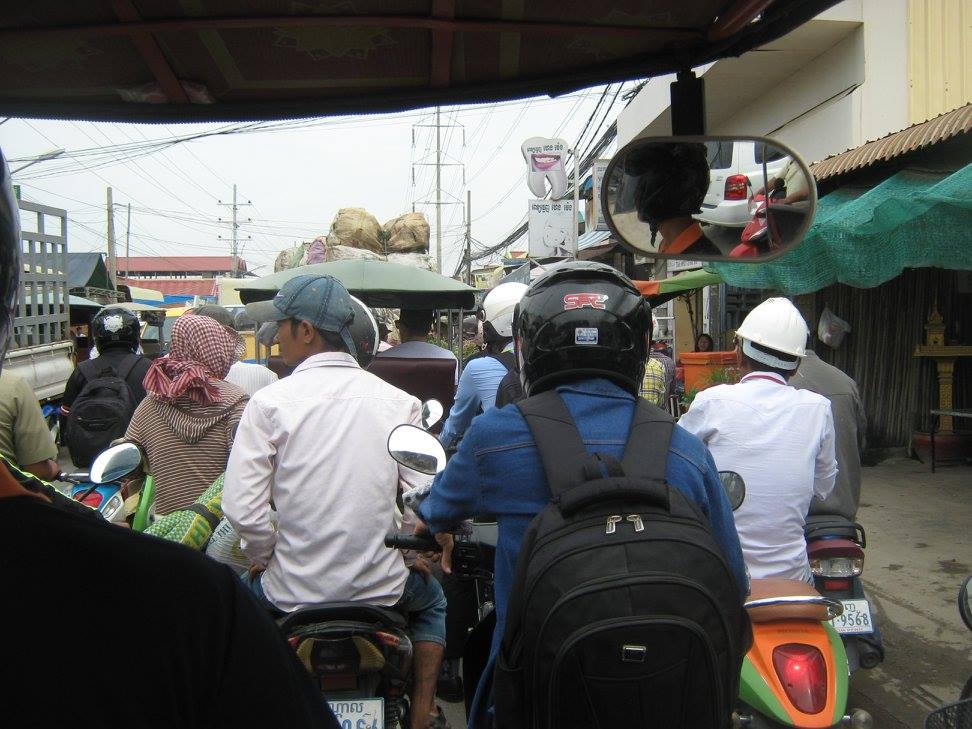
    Tuk tuk drivers are the contemporary dancers of south east Asia.  They weave in and out of traffic like gentle anarchists of the road, and they have sublime balance.  Mr Yous started telling me about his tuk tuk “it’s a Honda Dream with a 125 engine” he said and I smiled and I nodded.  He continued “it was 800 dollars so my brother gave me half of the money and together we drive the tourists around” and again I nodded and I smiled. I told him that I thought it must be very hard to drive in the traffic and the heat, but to this he made no reply.  And when I said I thought he was an excellent driver, he smiled at me in the rear view mirror and for some reason I felt embarrassed.

    We stopped at a Temple for a blessing.  There were two women sitting under an enormous Buddha statue dressed in saffron, but with very little else around them.  I sat down next to the women and they started chanting and they gave me two sticks of incense to hold.  They tied two pieces of wool around my wrist, which were symbols of the blessings, and these red and yellow bands would protect me while I was travelling.  One woman encouraged me to stand up and bow in front of the statue, to present him with the incense I had been given, and so I did.  I bowed once, twice, three times before setting the incense into the bowls beneath him and I silently said thank you.  I put on my shoes and went to find Mr Yous.

    We left the temple behind us and headed towards the Killing Fields.  A tourist attraction of a grisly nature, yet one I had to visit as I’d promised my new Cambodian friends up north that I would before leaving.  But as we approached the gate I started to change my mind. I didn’t want to go in; it was dentist fear, exam day fear, first day in a new town fear.  I didn’t want to go in.  But in I walked and bought my ticket and a headphone kit with all the guided information in English a woman could ever want.

    And so the voice on the headphones began…

    “Welcome to Cheung Ek or The Killing Fields of Cambodia.  Perhaps it should be called “one” of the Killing Fields as there are still so many others lost in jungle, under leaves and beneath memories.  But Cheung Ek is the most visited and notorious because maybe it was the best one.  Sometimes the Khmer Rouge killed 300 people a day here”.

    For the next two hours I walked around a piece of ground which marks the brutal site where thousands of Cambodians were killed by the Khmer Rouge in the early 1970s.  Where no one knows the exact number of deaths, because every year and after the rains, more fragments of bone and cloth are uncovered.  A place where, because the bullets were so expensive, the killers had to be resourceful and so they used bamboo sticks, the bark of trees and hoes to silence the enemies of the revolution.

    Perhaps you stop counting deaths after a while.

    The voice on my headset hadn’t finished telling me details, but I had to leave that place.  So I went outside to find Mr Yous and his tuk tuk.  He was there, talking to other drivers and eating some Durian.

    “Are you ok, did something happen?” He asked me.

    “No I’m fine, can we go please?”

    “Of course.  Would you like some fruit or coffee?  Perhaps some water?”  But I said no and got into the tuk tuk and I didn’t look behind me.

    I was still catching my breath when I realised that Mr Yous was driving me directly from the Killing Fields to Tuol Sleng on street 113.  He pulled up outside and smiled like a Prince and said

    “Please observe my country a little more and then we will go to the market”.

    So dutifully I did.  Tuol Sleng was a plain old secondary school in the early 70s before the Khmer Rouge realised that it would make an efficient torture camp.  Instead of chalk boards, paintings and timetables of school activities, the walls of this old institution are packed with photographs of every man, woman and child who spent time there.  And who then died there.  I started to think about the photographers of the regime who had to prepare film, buy chemicals for developing the portraits and write up the biographies to go with the shots.   They must have made choices only fit for the nightmares of the insane.

    I sat on a bench under a tree and looked at the school from the outside.  It really did look just like any other school in the city, and I couldn’t process the information that I had been given.  So I stood up and left the place and found Mr Yous, waiting for me one more time.

    He looked concerned for me and asked me if I was feeling well.  He told me that sometimes the foreigners felt sick from the sun or the food or the water, but I assured him that wasn’t the case.

    Actually, as it was near enough to cocktail hour I asked him to take me to a bar.  Any bar.  Anywhere in the city.  But preferably somewhere far away from torture, genocide and death.  So he smiled and drove me straight to the Foreign Correspondents Club near the Mekong River and I headed straight for the balcony on the very first floor.  I invited him in to join me for a beer, but when he shook his head and said “no thank you” I felt embarrassed for the second time that day.

    I asked the tiny waitress for a glass of white wine and she said “for you today, happy hour” so I relaxed and made myself quite comfortable.  I sat at the bar, watched her serve foreigners, laugh with her colleagues, and occasionally hit her arm or leg to keep mosquitoes away.  I smoked cigarettes and wrote three postcards home, ordered more wine and talked to a geologist from Minnesota about the dangers of ice-fishing.  I stared out at the Mekong River and watched the boats sailing and I watched the sun go down.

    When I finally left the bar Mr Yous was in his tuk tuk, waiting to drive me home.  But when we arrived at street 322 I could only find a 20 dollar note instead of the 10 dollars we had agreed earlier that day, so I told him to keep the change.  Now it was his time to look embarrassed and while he tried to give me change, I refused it, and I headed inside to my air conditioned room with the clean sheets and soft pillows and I fell asleep immediately.  I had expected to dream of the people from the black and white photographs, but instead I dreamt of Chankrisna. She was swimming in the Gulf of Thailand together with turtles, bannerfish, seahorses and dolphins.  And she looked as happy as children swimming often do.

    The next morning, I went downstairs to the reception and there on the counter was a small envelope with my name on it. There was a crisp 10 dollar bill inside with a few neatly written words in English on the inside of the envelope.

    The words simply said “Thank you.  From Mr Yous, the tuk tuk driver”.

  • Long story short

    A day I remember was the beach street party we had in the summer of 1978 in a small town in south Wales. Our street was alive with activities surrounding a small inflatable paddling pool on the concrete pavement outside the terraced houses of Alexandra Street. Women were sitting on deckchairs, the ice-cream van was parked outside number 35 selling cones with chocolate flakes and rasberry syrup and even the dogs were on holidays.

    All the children were wearing their shorts and t.shirts or some in swimming costumes and David Jenkins was wearing a snorkling mask and flippers. Some one had brought a record player outside which was shouting out old 33s…Boney M’s “Brown Girl in the Ring” receiving the most play time. Two or three of the men were in the shade sharing beers and cigarettes and only one neighbour, Mrs Williams from number 12 didn’t join in. She kept her curtains closed and cancelled the sun and said “I’m not going to no beach party in the street. It’s senseless.”

    The summer of 78 was a tiring time for me. I was starting to decide what I wanted to be when I grew up and it was all consuming. I was deliberating between being Nadia Comaneci, a waitress, a vet or a princess and it was exhausting. I practised my gymnastics religiously and my floor routine consisted of a hand stand, two roly polies and a star jump to finish. I would make my mother do the live commentary throughout so she would say things like “and here’s Nadia Comaneci on the floor again and isn’t she amazing…” My father’s role was to award me perfect scores of 10 and to present me with a medal at the end. On other days I would practise waitressing by clearing up the cups, washing out the ashtrays, moving plates even before my parents had finished with them. Practising vetinary science was more problematic, although we had a cat so she endured some treatments and examinations regularly. While trying out my princess skills involved a lot of waving.  It was endless.

    78 was also the summer I experienced grief for the first time. Two close friends, Alvie and Suzie died in quite violent accidents. Alvie and Suzie were my imaginary friends, who lived on the mountain opposite our house, and they had been a very important part of my life. But they both met with early deaths that summer, Alvie by falling down the toilet and drowning and Suzie by falling into the back of the old black and white television in our living room. These deaths concerned me, but they didn’t interupt my gymnastics, waitressing apprenticeship, vetinary or princess skills.

    But on this day in 1978, we didn’t think about fallings, ambitions or worries, we just enjoyed the sunshine and the music.

    “Brown girl in the ring, tra la la la la…”

    My father had a polaroid camera and he documented the day. Faded colours of people smiling, dancing, talking and having fun. It didn’t finish until well after mid-night. Some tired children had found sofas or their own beds, but I wasn’t sleepy at all and I stayed awake the longest. The sun had long set, but like those July nights of the 70s and my own memories, it still wasn’t really dark yet and you didn’t need a jumper.

    David Jenkins’ father was the first to start clearing up. He emptied the water from the inflatable paddling pool into the street gutter and he put the empty beer cans and plastic cups into a bin bag. He said to me “it’s late, you should go to bed now” but I didn’t want to. I liked hearing the grown-ups talk in their funny drunk voices and I wanted it to go on forever. But in the end, my mother took me by the hand and we walked the few paces to our house. I fell asleep quickly to the sound of the last of the adults laughing and to the rhythm of Boney M.

    “Brown girl in the ring, tra la la la la
    She looks like a sugar in a plum
    Plum plum”.

  • Dear all signs

    Dear all signs

    Elaine Benbury used the pen-name “Mysterious Maggie” when she started writing horoscopes for a popular women’s magazine in the spring of 1972. The magazine, which had a small but loyal readership, was called “Women – hey!” and was filled with cookery tips, interior design techniques, fashion and some real life stories of hope. For almost forty years Mysterious Maggie contributed to the star sign page, and she never once failed to file her work before, or on the deadline of each issue.

    For her first three horoscopes of 1972, she wrote mostly vague predictions which gained little or no attention from the readers of “Women – hey!”

    Dear Capricorns,

    This month something interesting will happen to you at work, something nice will happen in your social life and something else will happen at home.

    Elaine had wandered into fortune telling unexpectedly and at first she felt a little uneasy in the world of tarot, palm reading and crystal balls. Elaine tried several occupations before the world of the semi-occult enchanted her, including tele-sales, marketing, child minding and nude portrait modeling. But none of them provided her with the satisfaction of deciding people’s futures for them. It was like playing with dolls, with lots and plenty of tiny little dolls, and Elaine had always loved playing with dolls when she was a little girl.

    After her vague predictions of spring and summer ’72 Elaine started to discover that she could actually predict the future for strangers. When close friends asked her if she could actually see into the future, she would reply “probably” because the real mystery of it all was that she actually didn’t know herself. She knew from the fan mail from her loyal base that she was right at least 50% of the time, and to Elaine Benbury, this signified success. What she knew for certain was that every morning she got up, put on the radio and waited for a sentence or two to come into her mind. Once it came, she grabbed it, recorded it, wrote it down and kept it and that would be the prediction for that particular sign that month. Close friends would also beg her to tell their fortunes at dinners or other social occasions, but the fact of the matter was, she couldn’t do it live. She could only write it down.

    At first she felt a little ashamed and thought that she ought to read up or study palm reading, tarot, shamanism or crystal ball reading. But no sooner had she put pen to paper than she realised that she could actually do this work without training or experience, and this pleased her no end.

    Elaine went through many phases during her almost 40 years of predicting, eventually winning “Horoscope writer of the year award” for ten consecutive seasons, from 2001 – until 2011.

    However she wasn’t always as successful. Her initial vague period of early 1972 was replaced by a floaty period which was met with very little interest from the readers of “Women – hey!”

    Dear Aries,

    There will be lively green seas surrounding your aura this month and like a gentle bull, you will need to pull away from the softness carefully.

    This so-called floaty period, was replaced by an unwise Shakespearan era, which lasted until the autumn of 1982.

    Dear Taurus,

    Thou doth knoweth in thine heart, oh beloved Taurus that the future is like a sea unknown by all men, and their women folk neither. Hark, who cometh? Wait, oh prey that my love and your love endeth this night. Blessed be this night.

    Elaine enjoyed an interest in horticulture, which also showed its face on her pages during issues in the late 80s.

    Dear Leos,

    You are a rose, and like all roses, tulips and daffodils, you are a delight. You grow Leo, tall and strong and regal and proper. Let those roots of yours stay as firm as they can be and let your soil feed your own energy and love feed your core.

    Elaine also went through a cynical and bitter period during the summer of 1986 when her lover and best friend, the Slovak graphic designer Olga, left her.

    Dear Sagittarii

    Never trust a Sagittarian! You fucking two faced hypocritical sign from hell. Why don’t you just throw yourselves off a platform into an oncoming train? Hey? Just like Ana fucking Karenina, another two timing fucking whore.

    Which was itself replaced by a mellow, yet existential phase until the early 90s

    Hey Geminis,

    There’s no point to it all really is there? Not when you think about it rationally.  So why don’t you just leave your job, tell your lover your moving to Reno, and forget to feed the cat, I mean who would really care anyway.

    But after several meetings with the editor of “Women, hey!” Elaine finally found her form in early 91 and wrote consistently to all her ladies from there on inwards. Women liked her tone and her humour and they felt, they really did feel, that she was writing to them and to them alone.

    Dear Mysterious Maggie,

    Last month you told me that there were waves of great change about to lap through my life and only last weekend I met a man who loves to surf!!! Imagine! You are a miracle and a wonder and I love you.

    (name and address with held).

    But then without warning or mention to her editor of 40 years, Elaine filed her last predictions recently in January 2015, with just one last future intention for all her readers.

    Dear all signs,

    You are about to loose a presence in your life that is similar to a mother, teacher, secret friend or nurse. Don’t be sad or concerned. Just try now to find your own unique answers to your own imaginative questions. The journey is long and you have to find your own way of reading the map, I could only ever help turn the style. Remember that the butterfly, who sits on the nose of a crocodile, is never in danger. And remember too, that I love you with the whole of my heart, and I always will.

    Mysterious Maggie.

    The January issue of “Women – hey” is said to be a collectors’ item already within the small community of Maggie fans, and a commemorative copy is available online.

  • Chinese Lanterns

    If I were the woman, who lives down the hall from me, I would wear ostrich-skin, calf-length, cowboy boots in alligator colours.  I would drape a pashmina shawl over my shoulders and I would eat coconut ice-cream daily.  I would hire the greatest of Czech musicians and a troupe of Shakespearan actors to play and entertain me on Sunday evenings. And if I were the woman, who lives down the hall from me, I would keep kittens.

    If I were the woman, who lives down the hall from me, I would make roller-skating compulsory, apple orchards a necessity and car alarms obsolete.  I would banish the rain.

    I would make a Chinese lantern and let it float silently, way above St. Xavier’s church towards the Gobi.  There it would watch yaks on the steppe, camels walking by, wolves waking at sunset.  The desert winds would shake it sideways, but it would love watching herders’ families moving nearer to fresh grass and it would see the new horizon.  It would be its own collapsible integrity, a letter in calligraphy, rice paper and bamboo.  It would banish the rain.

  • Yellow Roses

    The framed black and white photograph of their wedding day had been a gift from Hayat’s father.  He insisted.  He paid for the feast, for the lace for her dress, for the gold rings and for the flowers throughout the celebration.  The picture hung in her room for the whole of her life, and while she got older and older, the photo of her young self moved further and further away.

    The beginning of the wedding day had not gone so well.

    Hayat remembered an anxious morning with her sisters and her female cousins fussing around her, painting her face and hands, curling her hair and giggling.  And she remembered a sense of doubt.  What if she didn’t love Abdul in the way that she should or in the way that others told her she would in time?  What if she didn’t even like him?

    The wedding party finally left the house for the ceremony, and she and her mother were the last ones to leave.  She hated seeing that room for one last time as a single girl, knowing she would only ever visit it again as a married woman.  And when Hayat’s mother started crying, it did nothing to ease the uncertainty.

    “Why are you crying mother?” she asked, but her mother didn’t reply.

    When the ceremony finally started, she could see that Abdul looked as scared as she was and this, strangely, helped her to relax and enjoy the attention of the day.  If he was nervous too, then at least they had one thing in common.  It turned out that the feast was delicious.  Everyone complimented her on the lace of her dress and both the quality and variety of the flowers.  Especially the yellow roses, everyone loved the yellow roses.  And by the time the sun set on the wedding party, she was laughing and dancing and happy.

    Hayat and Abdul lived.  They saved money.  They had children who were taught well, and they danced at other people’s weddings.  Everyone complimented Hayat because her oldest son completed university, and they said that Abdul’s shop was the best in the village.  Sometimes, if he had time and a little extra money, Abdul would buy yellow flowers for his wife.  Not always roses, if they couldn’t be found in the market, but yellow ones all the same.

    Hayat looked forward to her son’s wedding day, although she also feared it might never happen.  Lorni had made so many new friends at the university, and now that he worked in the city, his parents hardly ever saw him at all. When he did come back to the village, he brought Hayat items that she didn’t need for the kitchen, and spoke confidently about politics in his new found accent.  Lorni disagreed with his father’s ideas and Hayat was starting to feel that they, how could she put this, that they were starting to embarrass their eldest son.

    He visited less and less now and she noticed it more and more.  Hayat worried about all of her children, but it was Lorni she feared for most of all.  He was never going to be happy, she knew that about her son.  He was never going to be at peace.  He had no sense of acceptance, that this life was the way life should be.  And his search would only yield rotten fruit.  Lorni’s modern ideas didn’t frighten her at all, she wasn’t as provincial as her eldest son believed, but it was his sadness that concerned her.  He never showed joy, only anger and dissatisfaction and cynicism.  Abdul worried about his son too, but Hayat fretted.

    Lorni had been an unhappy baby.  Hayat remembered that he didn’t like to be held, he preferred to lie on the bed un-cradled and un-soothed.  She and Abdul, like all first time parents, followed the commands and instructions of all other parents before them, but nothing ever worked for Lorni.  He simply cried.  In the morning, in the afternoon and in the evening, but especially during the night-time, he cried.  The more they tried to comfort him the more distressed he became.  Hayat could still see the unsatisfied baby in her fully grown man child, and she worried all the more for him.  She worried, in particular, that she would never dance at his wedding or buy a black and white framed photograph of his wedding day.  She worried that he would never find anyone, to buy yellow flowers for.

  • The Retirement Party

    Joyce Fisher had known that the girls from the office were planning a surprise retirement party since she overheard them talking about it in the kitchen one day when she joined them for lunch un-expectantly.  Usually she went to the local café for her sandwich and earl grey tea with milk.  But one day she decided to venture upstairs and join the others for a chat.  They were all so surprised to see her there that they stopped their conversation immediately.  In particular, young Caitlin put away her notebook, which Joyce assumed, could have only contained some or all of the details for the party.

    As it turned out, lunch that day didn’t go so well.  Joyce didn’t really understand a lot of the conversation, jokes or references and it seemed, from time to time, that the girls might have even been making fun of her. Usually she liked to keep herself separate from them in order to keep a professional distance.  After all, she was the office manager of O’Sullivan and Sons and perhaps lunch was too intimate after all. Actually, young Caitlin wasn’t the worst of them.  But even she had a sly smile on occasions and had a habit of saying “I’ll try to get to that today” when Joyce gave her an instruction.  Caitlin had an unbearable habit of going swimming before work on Tuesdays and Thursdays and would arrive at the office with her hair still wet and placed in a messy knot on top of her head, like an ice-cream about to fall over.  Joyce had mentioned it once or twice to Mr O’Sullivan, but he had barely acknowledged the comment and nothing was done about her concerns.

    Mr O’Sullivan, or Dan as everyone else called him, was young, bright and handsome and ran the office with a casualness that his father, Mr O’Sullivan senior, would never have approved of.  Mr O’Sullivan senior, had been an aloof, distant and robust boss who was firm but fair.  He was proper and professional and Joyce missed him every day.  She had started working with him in the summer of ‘66 and had fallen in love with him immediately.  The affair only lasted that first summer, but even afterwards she respected him.  She respected him for the gentlemanly way he had ended the relationship and yet managed to keep a decent working relationship with her, until his death in 1984. But as soon as Dan took over things changed.  Out went the old typewriters and dictaphones and in came open plan office space, plants and computers.  She had seen so many changes over the years.

    But she had decided that she would attend the surprise retirement party.  She would be gracious for the gifts, the speeches, the flowers and then head home early leaving the youngsters to go off dancing or whatever it was they did with their work nights out when she wasn’t around. On her last day, a Thursday, she decided to wear something a little less formal than her suits and chose a yellow dress she had worn to her god son’s wedding two years earlier.  She came into the office and was met by Caitlin, fresh in from her swim.

    “Morning Joyce, ah you look lovely today, what a gorgeous dress”.

    “Thank you Caitlin – now if you come to me at 9.15am and we can go through Mr O’Sullivan’s diary for next month.  There are a few things we need to discuss by close of business today”.

    “No worries.  I’ll come to your office in five”.

    Joyce didn’t actually have an office, not since the refurbishment.  But everyone called her desk, which was surrounded like a fort by the photocopier and filing cupboards, her office.  Caitlin came to her, with a cup of tea in her china cup and saucer, and they began to discuss Dan’s diary for April.  Caitlin wasn’t paying as much attention to the diary as Joyce would have liked. In fact, she was hardly writing anything down at all and when Joyce questioned her about it, she simply said “a lot of this stuff is in the CAB”

    “The CAB?”

    “Central appointments bookings”

    “Of course”. About half way through the meeting, Caitlin said “Sorry Joyce, I really have to run now.  I have a 10.00am with Dan, so we’re going to have to leave it there.  I guess you can spend the rest of the day with your feet up?”

    “With my feet up, certainly not” said Joyce.

    Joyce spent the rest of the morning responding to emails, sending personal farewells to old time clients and clearing her desk of personal items.  A few photos of the god son, her own personal stationery, and her china cup and saucer needed to be taken home.   How odd it would be to not come into number 28 Baggot Street every morning.  She wasn’t afraid of retiring.  She had many hobbies including her garden, chess, and book club of course.  But it would be strange not to be in work every day, to be suddenly so dispensable. How the office had changed since ‘66.  Back in the day you could smoke in the office, make jokes that wouldn’t offend anyone, and people wore suits with polished shoes.

    Nowadays the entire staff had MBAs and were constantly attending training sessions to “up-skill”.  Joyce had attended a training session once and was horrified to find a twenty year old in jeans and a logo t.shirt write-up a selection of words on flip-chart paper and expect it to mean something.  At the end of the day the participants had to write one word on the paper to express how they felt.  Joyce had written the word “exasperated”. At 4.45pm Joyce went to the bathroom and applied some pink lipstick, she brushed her hair and sprayed a little perfume.  Usually she didn’t like the other girls using the bathroom as a changing room, but this was an exception.  This was her surprise retirement party and she had decided to breathe a little easier.  Actually, she felt quite brazen during the mini-pampering she gave herself while the others were working outside.

    But when she came back into the main office her heart sank.

    All of the girls, including Caitlin, were getting ready to leave and were talking about “Happy Hour” in the bar across the street.  Happy Hour!  Two for the price of one!  Surely they didn’t expect her to sit on a high stool with her feet dangling, sipping a brightly coloured drink from a straw.  Thankfully, they weren’t expecting anything of her at all. As they continued to put on their coats and cheap jackets, they stared saying things to her like “all the best now Joyce” or “take it easy” or even “fair play to you Joyce” and they left the office without her.  Not a bunch of flowers or a card, not even a gift voucher to say goodbye.  And Dan himself, the handsome clever son of Mr O’Sullivan senior, wasn’t even there.  She wanted to cry but decided not to.  She gathered the last of her personal items from her desk.  She turned out the office lights and locked the door and walked along the street alone.

  • 930

    930

    She was packing up children’s story books earlier today when it was foggy and dull outside.  The packing had taken all afternoon.  She developed a system where she could neatly bundle packages of 30 books together into tightly closed boxes.  She could then label them, cellotape them and put them into the corner of the room for collection later.  She was listening to the radio and was almost enjoying her plod through the 930 story books for children, when she quite violently cut her finger wide open.  She popped her finger into her mouth, to stop the blood from staining the boxes, but the taste repulsed her.  She thought about locating a first aid box.  Could it be in the bathroom?  No.  Under the black leather sofa that so few people sat on?  Oh no.  So she tried inside of the far pit of the cupboard, where the books had lived, maybe, just maybe…

    She rescued an old water-proof plaster from the depths of a medi-box where she also found a picture.  A small hand-painted picture of a village in Tanzania, in reds and browns and oranges.   The dust of the roads there, reflected so perfectly onto the yellow cloth in her hand, reminded her of Nathanial.  Not Nathan or Nat, but Nathanial who had bought the picture to wish her farewell, and to ask her to remember him safely.  And she had carefully remembered him through a couple of seasons and anecdotes over dinners at Christmas.  But here he was stuffed away under an old out-of-date first aid kit.  Out of sight and so far removed from her mind, it was like she had never seen any colours before, let alone the vivid, splendid colours of Tanzania.

    Nathanial was a teacher in a primary school and he loved telling stories to his pupils.  They demanded he tell them tales “from his head” and not from the page, so he obliged every day after maths.  He would tell them stories about gardens and singing, the ocean near Dar-es-Salam, but their favourite was the one about butterflies.

    Nathanial came from a village called Funusi, where they liked to grow butterflies.  His sisters and mother raised the eggs, and he helped every summer when he went to his home up north.  Together the family would protect the eggs from the dangers of predators and when the caterpillars matured and mutated, Nathanial liked to watch.

    “But” he told the children “I have never once seen one change”.

    Sometimes, the women from Funusi would sell the larvae directly to owners of botanical gardens, small zoos and petting farms in America and Europe.  And when Nathanial told the children this fact, they would laugh and scream and clap their hands.  Even the older children in the class, who were concentrating on their letters, would allow themselves a wry smile, despite having heard the tale before.

    “The butterflies fly in a plane?” the younger ones would ask.

    “Not the butterflies, nor indeed the caterpillars, but the larvae children, the larvae are flown in planes” he would tell them.

    Still they would laugh out loud and leave their chairs, punching the air and whistling.  Nathanial would allow them to shriek for a while and then he would need to calm them and restore order before the principle came.  He would do this by opening his maths book or returning to the chalk board and once again quiet would be redeemed.

    Then the children would know that the story was over.

  • Another Year’s Intentions

    Gomera 071
    I’m going to keep swimming in the salty cerulean sea of Gomera. Stepping over the calm waves and wading in gently. Watching the sun setting while Atlantic breezes whisper past me and nudge me towards happiness. I’m going to keep a plate of fish next to me and give thanks for the bread which accompanies it, made soft with island butter and warm hands. I’m going to keep the quiet sleep for evenings, when rested after a day’s contentment, the nightmares cease to be, and even the crisp white sheets look rested early the next morning.
    Go away then sad anger, which like a devil, appears without invitation and outstays its welcome. May you be lost to me, lost at sea, drowned like the crew of a doomed wooden vessel. Captain and all. Go away then idle gossip, may you fly away on a sea breeze, to unmapped, undiscovered, distant lands.  And go away moons of madness, those pale white shadows from tomorrow which ruin today, when they settle. I want no more of you. I loose you and ignore you, leave and abandon you and wish to see no more of you.

    Gomera 072

  • Skimming Stones

    The Bishops came from a long line of circus performers, and like so many families before them, had lost several relatives to tragedy many times.  A trapeze calamity here, a fire-eating accident there; uncles, cousins and aunts had died during their last performances, but none was remembered as fondly or talked about as often as Vincent Bishop, the tightrope walker.

    Vincent Bishop, handsome, fearless and strong, was very popular in Asia, in particular by the Janbaz Circus people of Pakistan and the Tirana group of Albania.  In his publicity photographs he looked more like a 1950s movie star than a man who lived in a tent, and girls, and women and young men adored him.

    His brother, David Bishop, was a tall man, so genetics cheated him out of the family business of tightrope walking, yet, saved him from the pre-mature and violent death of his twin brother, Vincent.  Vincent was always the more spectacular of the twins, and even in death people preferred him.  They constantly talked about the day when Vincent set-out on his final walk in Uzbekistan.  No one ever really knew what happened on that fateful day, that clear blue sky morning, and no one ever would.

    “Simply wasn’t his day” was all his sister Edith said afterwards.  And she knew a thing or two about it not being your day.

    Edith Bishop was one of those unfortunate women who were almost too beautiful in their youth to invest time or energy into cultivating a replacement for the day that that beauty would leave her.  Her entire act, as the woman men threw knives at, was based on her innocence, slight frame and peculiar exquisiteness.  When these attributes abandoned her, like a surprise breeze in July, she was older than she should have been, potentially homeless and unemployed.

    But her father, Mr Bishop, never let old performers sit-out in the rain, and so he kept her on to sew costumes, make tea, sell tickets for the show and keep her surviving brother company.  The others referred to her as “old Edith” when she was just 37.

    After the evening shows, Edith and David spent their time re-visiting Vincent’s short life through their shoe box of carefully cut paper clippings, publicity shots and postcards.

    “Here’s one of him in Moscow” said Edith as if it were the first time she had ever seen it.  “So fearless, so brave” and she petted the side of the photograph as you would a small cat.  “Ah look at him in Pakistan” David echoed.  “So unique, so handsome, so concentrated.”

    David Bishop still had the physique and awkwardness of a pre-adolescent boy even in his 50s, and he also had a slight stammer, which kept him away from strangers and new friends.  He tried several circus skills in his career, such as juggling, clowning and uni-cycling but he wasn’t funny, courageous or sad in the ring, so his father put him backstage early in life.  In her youth, Edith ignored this brother, but time and traveling and remembering Vincent brought them closer, and she loved him very dearly now.

    One night after a particularly slow show when both the performers and audience seemed equally neglectful, Edith and David opened the shoe box carefully and began their ritual of photo gazing.

    “Ah, look at Vincent here when he was so young” cooed Edith in an almost maternal voice.  “That was the winter we went to Michigan, Vincent loved going ice-fishing, do you remember that David?  Do you?”

    David smiled and nodded, as he did every time she asked and he dutifully began the story.

    “Yes, Edith of course I do.  That was the winter of ’63 when we spent some time near Lake Saint Claire” he said.  “We were resting after a summer of record sales and Vincent was practising his balance on the ice.  He loved it”.  David took a short break to roll a cigarette and to pour some tea.  Edith’s silence suggested he should continue and so he did.

    “Vincent was so young that winter” said David.  “He loved having the evenings to play with instead of waiting for the curtain to come-up and his favourite game of all was to throw rocks over the ice, to see how far they would fly.  He loved the twilight and would play for hours until someone would go and find him, to bring him home for tea and to get him into bed.  He talked of nothing else for months and months other than the sound of skimming stones on the ice on Lake Saint Claire, and how wonderful he felt there”.

    Edith smiled, David put out the fire, and the two went to bed and to sleep.